
A Premier League club calls Dr Michael Keane, Chief Science Officer at Evolve Neuro, with a familiar complaint. One of their most promising players keeps falling apart under pressure.
Something goes wrong in a match, a missed chance, a bad bounce, and he disappears into himself. All risk vanishes from his game.
The club's read is fragile nerves and a confidence problem, but Keane doesn't start by managing the symptoms.
The first step is an electroencephalogram (EEG), a recording of the brain's electrical activity. Keane combines it with psychological assessments to understand what's happening before deciding how to intervene.
What’s beneath the surface
For several weeks, his team tracked the player's EEG alongside a recurring mood assessment, and the story that emerged isn't the one the club had been telling.
The anxiety wasn't triggered by the bad moment on the pitch.
It had been climbing for roughly six weeks beforehand, quietly, while the player still had enough in reserve to hold it together. By the time it surfaced as a mistake in a match, the strain had already been building for a long time.
When Keane showed the data to the club and the player's mother, her reaction was immediate.
"This is exactly what I've been trying to tell them for the last five years."
After so much time of being dismissed as overreacting, she finally had something objective to point to.
So Keane and his team built a training program: neurofeedback to strengthen his ability to regulate under pressure, combined with psychological skill the player could use under pressure.
Within six weeks, it was, in Keane's words, "like flicking a switch." The player made his international debut soon afterward.
For Keane, that's the value of measuring first. It reveals what's happening beneath the surface instead of relying on what people think they see.
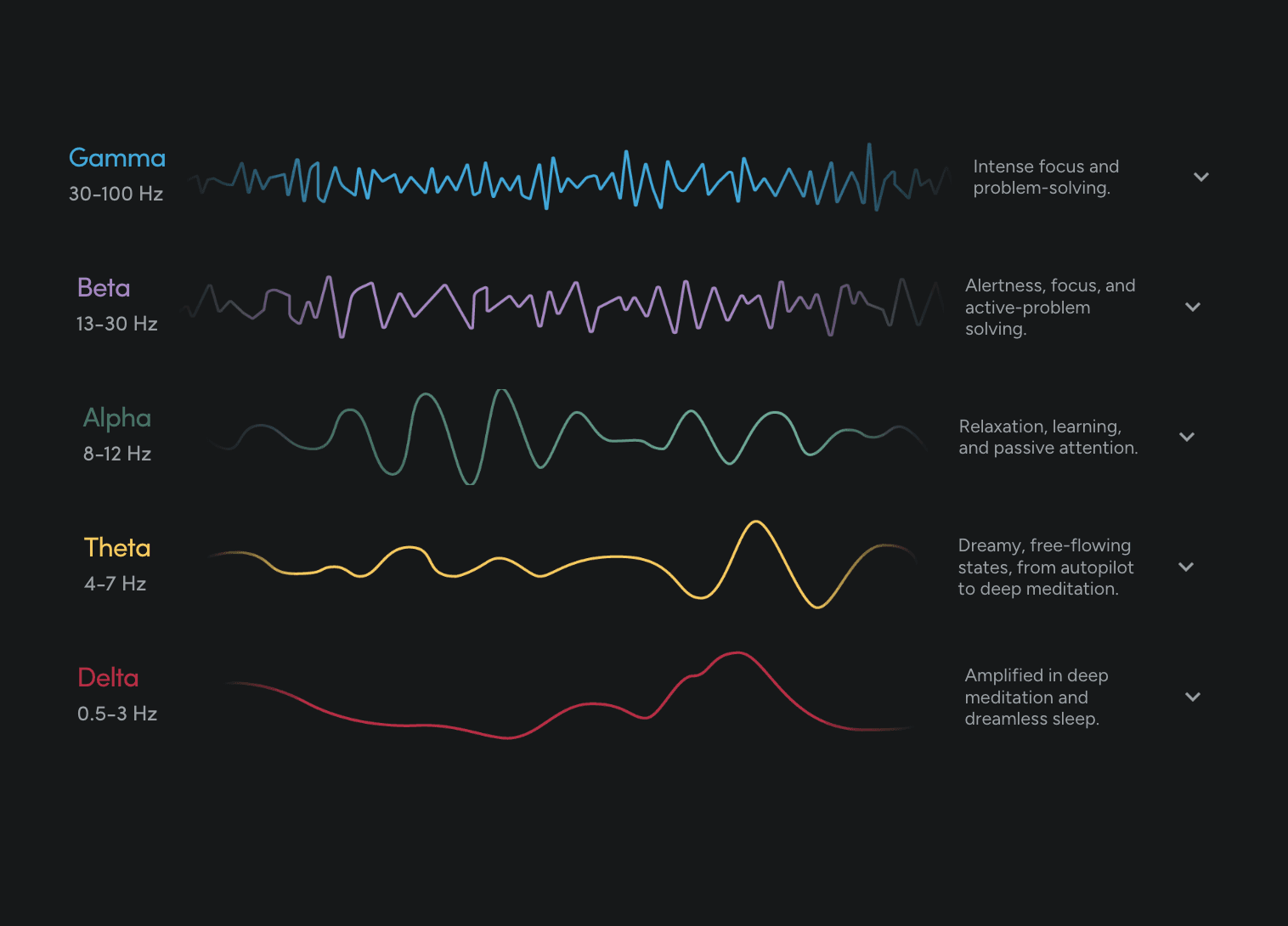
The brain produces electrical signals constantly, known as brainwaves. An EEG captures them in real time, organized by frequency. Each pattern is linked to a different mental state. For Keane, learning to read them is where everything begins.
Twenty years of looking at the brain
Keane co-founded Evolve Neuro with CEO Peter O'Mara Kane. O'Mara Kane came from digital advertising and startup scaling. Keane came from psychology, neuroscience, and medicine.
"Pete is really good at breadth," he says. "I'm very good at depth."
That mindset goes back more than twenty years. As a PhD student, Keane discovered his university had no EEG lab, so he built one.
The question that fascinated him then still guides his work today: What can brain activity tell us before symptoms become obvious?
Whether he's working with a Premier League footballer or someone struggling with anxiety, his approach stays the same. Measure first. Decide what needs to change second.
When brain data meets real life
Keane's usual method is to triangulate. Psychometrics and conversation on one side, and EEG on the other.
Sleep problems, for example, often turn out not to be about sleep at all. Underneath them, he sometimes finds unresolved shame, trauma, or chronic stress that the brain refuses to let go of after dark.
He's watched people who spent decades being told to "move on" finally, in his words, "feel believed."
More recently, mostly as proof of concept, he's started reading EEGs cold, with no prior conversation and no intake. He tells clients what their brain suggests is happening, based on twenty years of pattern recognition.
People describe the experience, he says, as feeling like they've "got a camera in their kitchen."
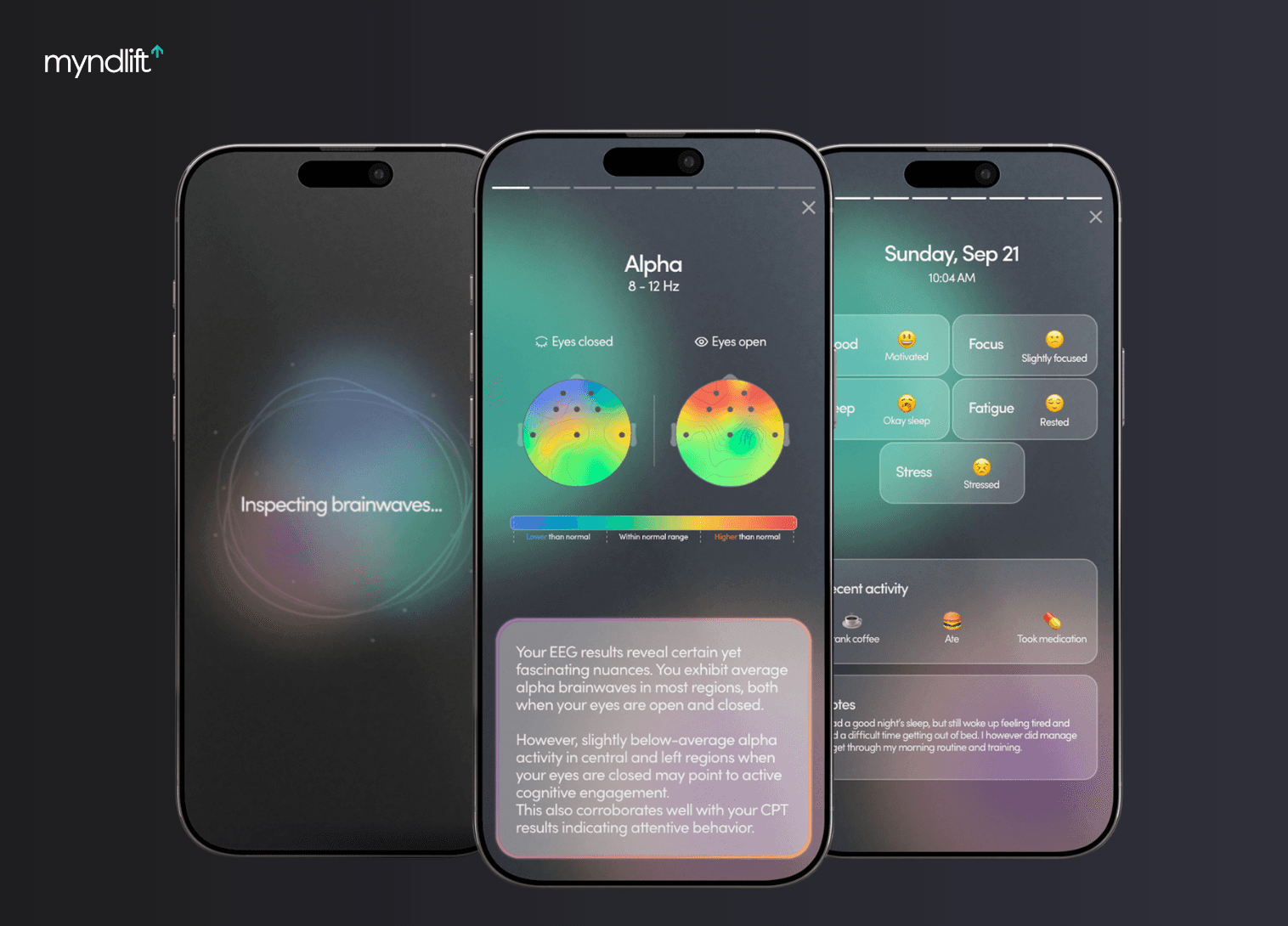
EEG results, presented and explained inside the Myndlift app.
From measurement to action
Measuring the brain is only the first step.
Once Keane understands the patterns he's looking at, he often uses neurofeedback, a form of personalized brain training that gives people real-time feedback on their brain activity.
Sensors measure brain activity while someone watches a video or plays a simple game. When the brain moves toward the desired pattern, the experience becomes more rewarding, for example by making the screen brighter. When it moves away, the feedback becomes less engaging.
Over time, the brain learns through repetition, without conscious effort, to spend more time in those healthier patterns.
This is what a neurofeedback session looks like inside the Myndlift app.
Training the nervous system like a muscle
Keane doesn't work from a single neurofeedback protocol. Every training plan is built around the individual assessment.
The goal is consistent: helping the prefrontal cortex, the part of the brain responsible for attention, decision-making, and self-control, come back online more quickly after stress.
He pairs that with techniques people can use in real time: on the sideline, in the car, mid-spiral.
His framing of stress is deliberately leveling. Keane argues that, from the brain's perspective, a packed stadium and overwhelming stress at home can trigger remarkably similar physiological responses. "Your brain treats it the same way," he says.
He's exacting about adherence. Neurofeedback sessions are short, fifteen to thirty minutes, three to five times a week.
He pushes clients to commit to specifics on the spot: where the EEG headband lives, what time training happens, whether the app is already installed. "Do not do four hours this week and no hours next week," he tells them. "You wouldn't do that with any other aspect of your training."
The goal is consistency, the same logic that governs any other kind of training.
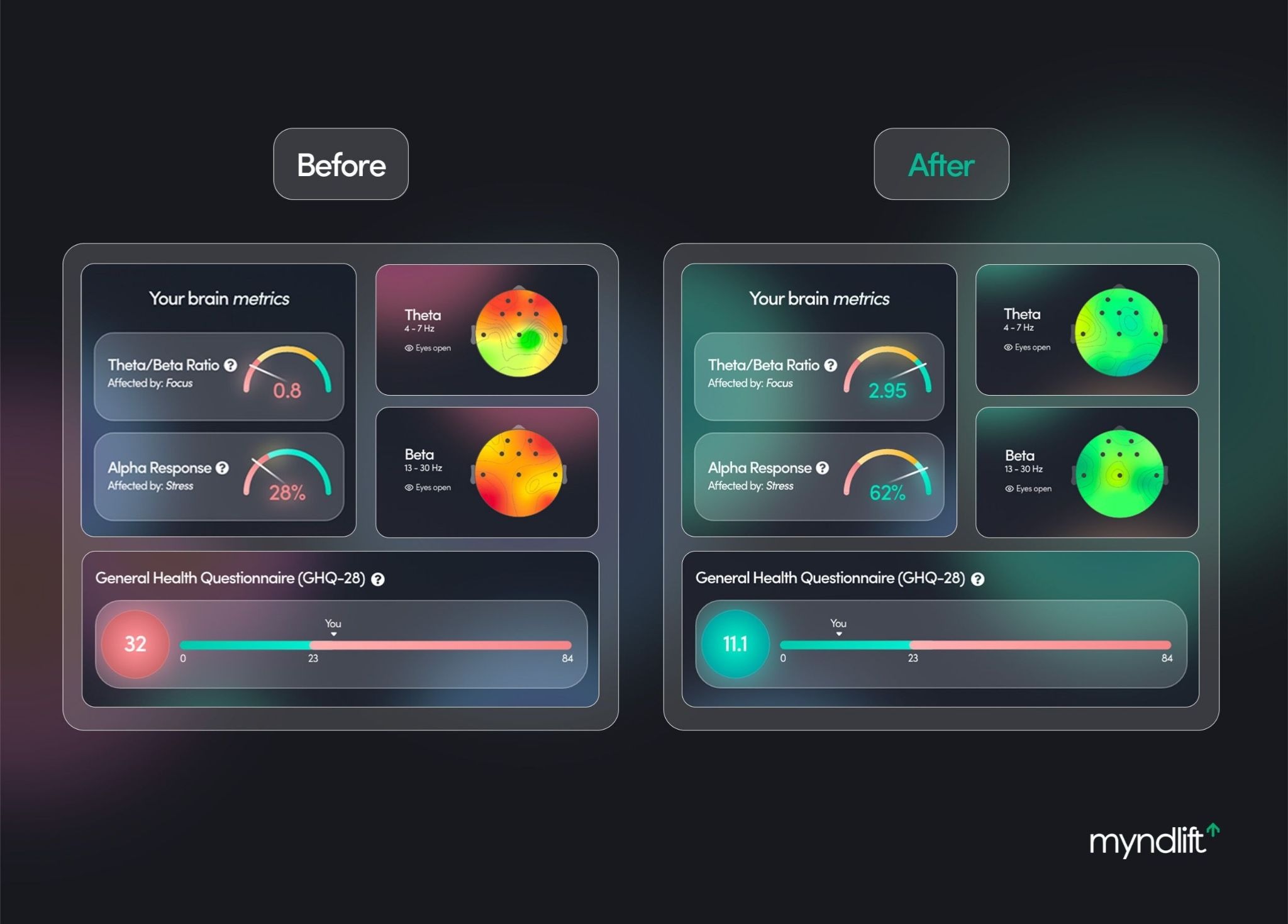
This is what progress looks like. EEG brain maps before and after neurofeedback training, captured inside the Myndlift app.
Why the app matters
Evolve Neuro has worked with Myndlift since its early days. For Keane, the platform's biggest advantage isn't simply that it allows people to train remotely.
"What I really like about the Myndlift dashboard is that you can deploy lots of different things. You can do neurofeedback, but you can also deploy questionnaires and mood check-ins. That gives real depth to the data."
As Keane highlights, knowing a clinician can see the progress also tends to keep people training, even between sessions, even when no one is actively checking in.
The other draw is simpler: it travels. One basketball team once asked Keane, with no apparent irony, whether they could train on the team's private jet.
The myth of the elite brain
It's tempting to think elite athletes simply have different brains. Keane used to think in those terms, clinical clients on one side, peak performers on the other.
Years inside Premier League and NFL locker rooms changed that. "People are people," he says now.
What he sees instead is the same volatile attentional wiring in elite athletes as in everyone else. Networks that are exceptional in bursts, but unreliable the rest of the time.
In a classroom, that volatility reads as a discipline problem. On a pitch, it reads as instinct, and it gets rewarded, by coaches, scouts, and parents, starting absurdly young.
In other words, context shapes the outcome more than the brain itself: the same trait that gets a kid labeled "difficult" in school gets him singled out as gifted on the pitch.
Strip away the stadium, and the stressors look surprisingly ordinary. Keane has talked to World Cup winners and Champions League finalists about what keeps them up at night.
"Their worries are the same as you and me," he says. Money, relationships, an argument from that morning, a kid struggling at school. The volume is different, but the wiring isn't.
The catch-22 of mental health
Most people already suspect they're underperforming their own potential. That's not the hard part, Keane says.
The hard part, as he puts it, is that "the very organ you need for activation is the organ that's affected."
His way in is measurement. Show someone their own data and the problem suddenly has edges. Action feels possible in a way it didn't when the problem was just a feeling.
He compares it to a visit to the doctor. Nobody wants to hear "everything seems fine" when something feels wrong. They want a name for it because a name implies a plan.
We don't expect someone with a fractured ankle to climb the stairs unassisted. Keane treats the brain the same way: not as a moral failing to overcome through willpower, but as a system that can be measured, understood, and trained.
If you want to train your brain with Myndlift:
Take our 10-second quiz to find your personalized, human-guided neurofeedback program.
If you're a clinician:
Myndlift helps practices deliver data-driven care with measurable outcomes. Schedule a demo and see how it works in practice.

Related posts