

Neurofeedback typically starts showing results between sessions 5–20, though the first signs are often subtle: falling asleep faster, recovering from stress more quickly, or feeling less mentally drained by evening
Early changes tend to be inconsistent: good days before stable patterns, and are frequently noticed by others (friends, family, coworkers) before you notice them yourself
Training frequency matters less than consistency: Dr. Lytle recommends twice a week as a starting point, but once a week can be enough depending on your goals
Myndlift data shows people who completed 10+ sessions in their first 30 days were 5x more likely to still be training at 6 months
A single Neuro Coach call made a significant difference in outcomes: people who had at least one were ~90% more likely to reach session 15 — the strongest predictor of long-term results
This article covers the full session-by-session timeline, expert insight from Dr. Lytle on what "working" actually looks like, and what Myndlift's proprietary training data says predicts success
Clinicians often highlight how it takes 3-4 weeks or roughly 6-8 neurofeedback sessions to notice results. And for many people, the first signs are quiet enough to miss entirely.
Before focus gets sharper or anxiety symptoms drop noticeably, people tend to notice smaller shifts, such as falling asleep faster, recovering from a stressful moment a little quicker than usual, and staying on task before having to force it.
But what if you've finished session 15, scrolled back through your training log, and still find yourself wondering: is anything actually happening?
We spoke with Dr. Lytle, a neurofeedback expert with over a decade of experience and one of the leading Neuro Coaches at Myndlift, to go deeper on what the early signs actually look like, and why the timeline looks different for everyone.
How long does it take to notice neurofeedback working?
As Dr. Lytle explains, while every brain responds differently, many people follow a similar pattern:
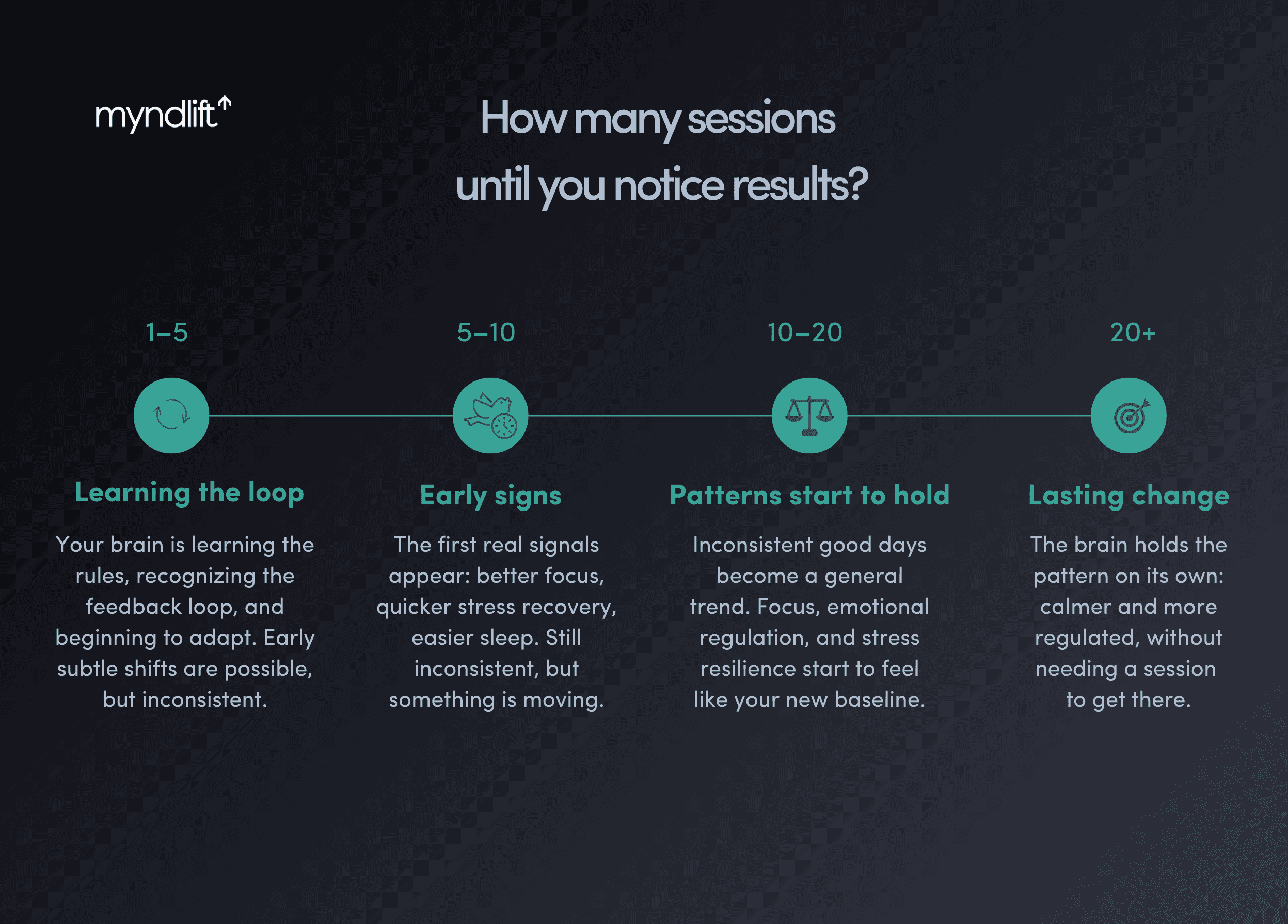
Sessions 1–5: Getting familiar with the process
Your brain is learning the feedback loop and adapting to a new experience.
Some people notice subtle changes after individual sessions, such as feeling more relaxed or mentally clear for a few hours. Others notice no immediate effects. Neither predicts whether neurofeedback will work long-term.
Sessions 5–10: Early signs begin to emerge
For some people, the first meaningful changes start to appear around this stage.
They are often subtle and inconsistent: stress feels a little easier to recover from, focus shows up more often, or emotional reactions feel slightly less intense. The changes may come and go rather than feel stable.
Sessions 10–20: Patterns start to hold
This is when many people begin reporting clearer day-to-day benefits.
Instead of occasional good days, they start noticing broader patterns: better focus, improved emotional regulation, more resilience to stress, or more consistent energy.
While there is no universal timeline, Dr. Lytle reports that benefits often become easier to recognize after several weeks of consistent training.
Sessions 20+: Building lasting change
Neurofeedback works through repetition. As training continues, the goal is for the brain to access these patterns more consistently outside of sessions.
Many neurofeedback programs involve 20–40 or more sessions because lasting changes tend to develop gradually over time rather than all at once.
Why does it take longer for some people than others?
Because every brain starts from a different place, and results show up in more than one form.
Dr. Lytle sees two distinct patterns play out with clients:
"In terms of results, there are usually two kinds: immediate and longer-term. Some people feel something during the session itself, like feeling calmer or more focused right away. Others don't notice much in the moment, but after a few weeks, they start to feel different in their day-to-day lives. Maybe they're more focused, less reactive, or just handling stress better. In many cases, it's not just the person who notices, it's their friends, family, or coworkers who say, 'You seem different, in a good way.' Typically, people start noticing these kinds of changes within 3–6 weeks of consistent training. But everyone's brain is different, which is why a personalized approach matters. There's no single protocol that works the same for everyone, so we tailor the training to fit you."
So, if you're three weeks in and haven't noticed anything yet, you're not behind schedule. You might just be in the second group.
Does training frequency change how fast you see results?
According to Dr. Lytle, less than most people assume, though consistency still matters more than intensity.
"I have some clients who train once a week, and that's enough for them. Others train twice a week, which I usually recommend as a good starting point. Then some clients train every day because they enjoy it or want to integrate it into their daily routine, like meditation. It really depends on your goals and your schedule. When we meet for our Neuro Coach sessions, we'll talk through what's realistic for you and what you're hoping to achieve. If you only have time a few times a week, that's totally fine. This is a flexible approach, not something you have to do daily unless that works for you”, explains Dr. Lytle
In other words, there's no minimum daily quota to hit. There is, however, a clear pattern in the data about what predicts whether someone sees results at all.
What actually predicts whether neurofeedback "works" for you?
1. Consistency early on
In an analysis of Myndlift training data, people who completed at least 10 sessions in their first 30 days were about 5x more likely to still be training at 180 days than those who didn't.
In other words, early consistency seems to build enough momentum and enough early evidence that something is shifting, to keep people going long enough for the bigger changes to show up.
2. Having support
The second pattern is about guidance and personalization.
In most cases, before training begins, a Neuro Coach builds a plan around your specific brain and goals. As sessions progress, they review how your brain is responding and adjust the protocol accordingly.
People who had at least one Neuro Coach call were about 90% more likely to still be training by session 15 than those who didn't.*
A single conversation doesn't change the brain. But it seems to change whether people stick around long enough. When someone can see your data, answer "is this working?" in real time, and adjust the plan as you go, the early ambiguity usually becomes a lot easier to sit with.
*Based on an analysis of Myndlift user data comparing session-15 retention between trainers who completed at least one Neuro Coach call and those who didn't.
Still have questions about your progress?
Everyone's brain moves at its own pace.
If you're not sure what you're noticing yet, or you want to talk through what your data is showing, your Neuro Coach is the right person to ask.
Myndlift offers a personalized, expert-guided brain training program designed to help you sleep better, focus longer, feel calmer, and manage your mood more effectively. Take this 10-second quiz to see if you're eligible.
FAQs
What's the very first thing people notice with neurofeedback?
Most often, it's something easy to overlook: falling asleep faster, recovering from stress more quickly, or feeling less mentally drained by the evening. Bigger changes in focus, mood, or anxiety tend to show up later.
How many sessions before neurofeedback starts working?
Early, inconsistent changes often appear between sessions 5 and 10. More stable, noticeable patterns tend to emerge between sessions 10 and 20. Dr. Lytle, a Myndlift Neuro Coach, says most clients notice changes within 3–6 weeks of consistent training.
Do I need to train every day for neurofeedback to work?
No. Some people train once a week and see results. Dr. Lytle typically recommends twice a week as a starting point, with daily training as an option for those who want it. What matters more than frequency is consistency over the first several weeks.
I've done 10+ sessions and don't feel different. Is that normal?
It's common, and it doesn't mean it isn't working. Some people's changes show up first to the people around them, not to themselves. This is also where talking to a Neuro Coach tends to make the biggest difference: people who had a coaching call were about 90% more likely to still be training by session 15.
Does talking to a Neuro Coach actually make a difference?
The data suggests yes. People who had at least one Neuro Coach call were nearly twice as likely to still be training by session 15 as those who didn't, likely because it helps connect early, subtle changes to what's coming next and resets expectations around the timeline.

Related posts


