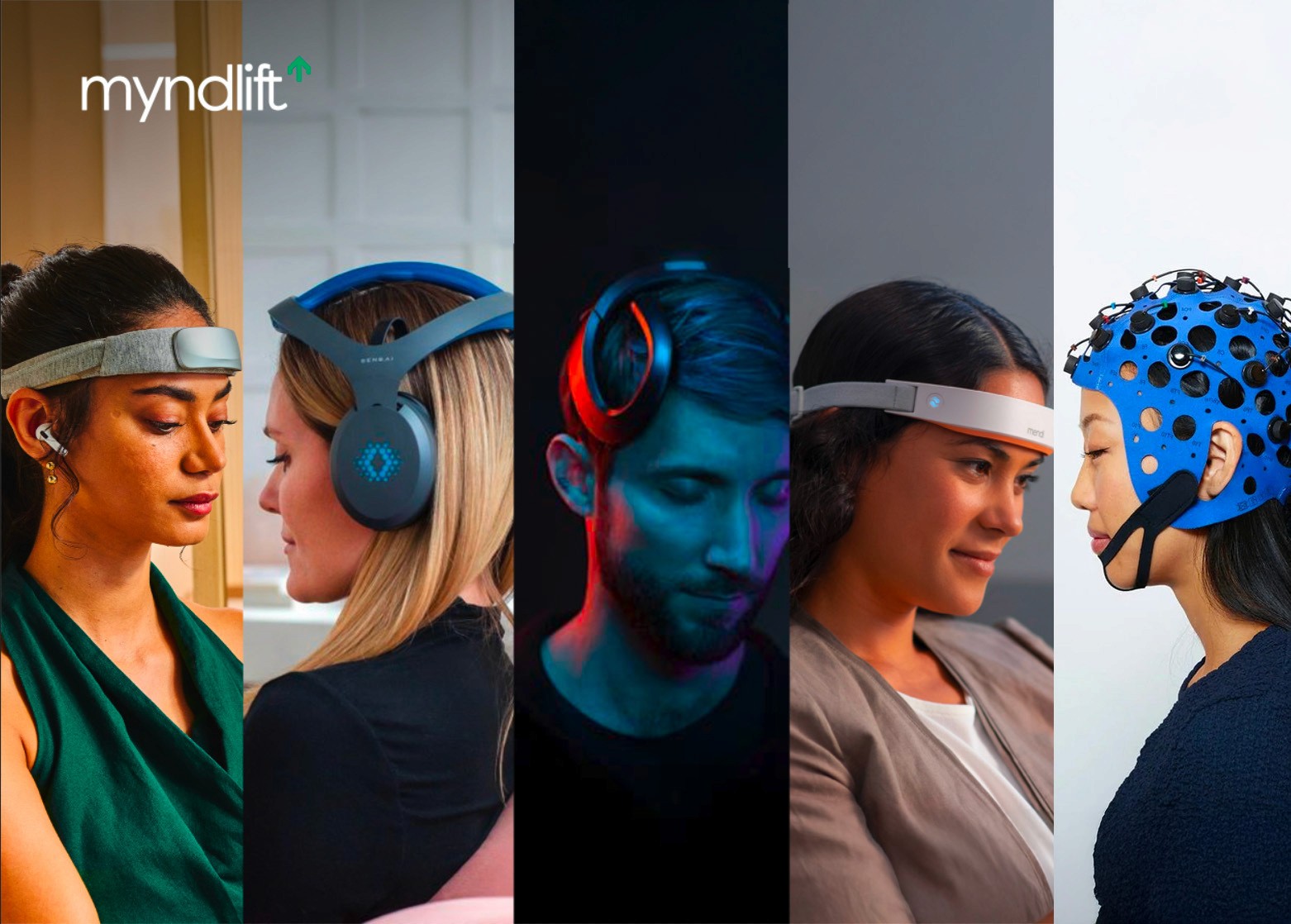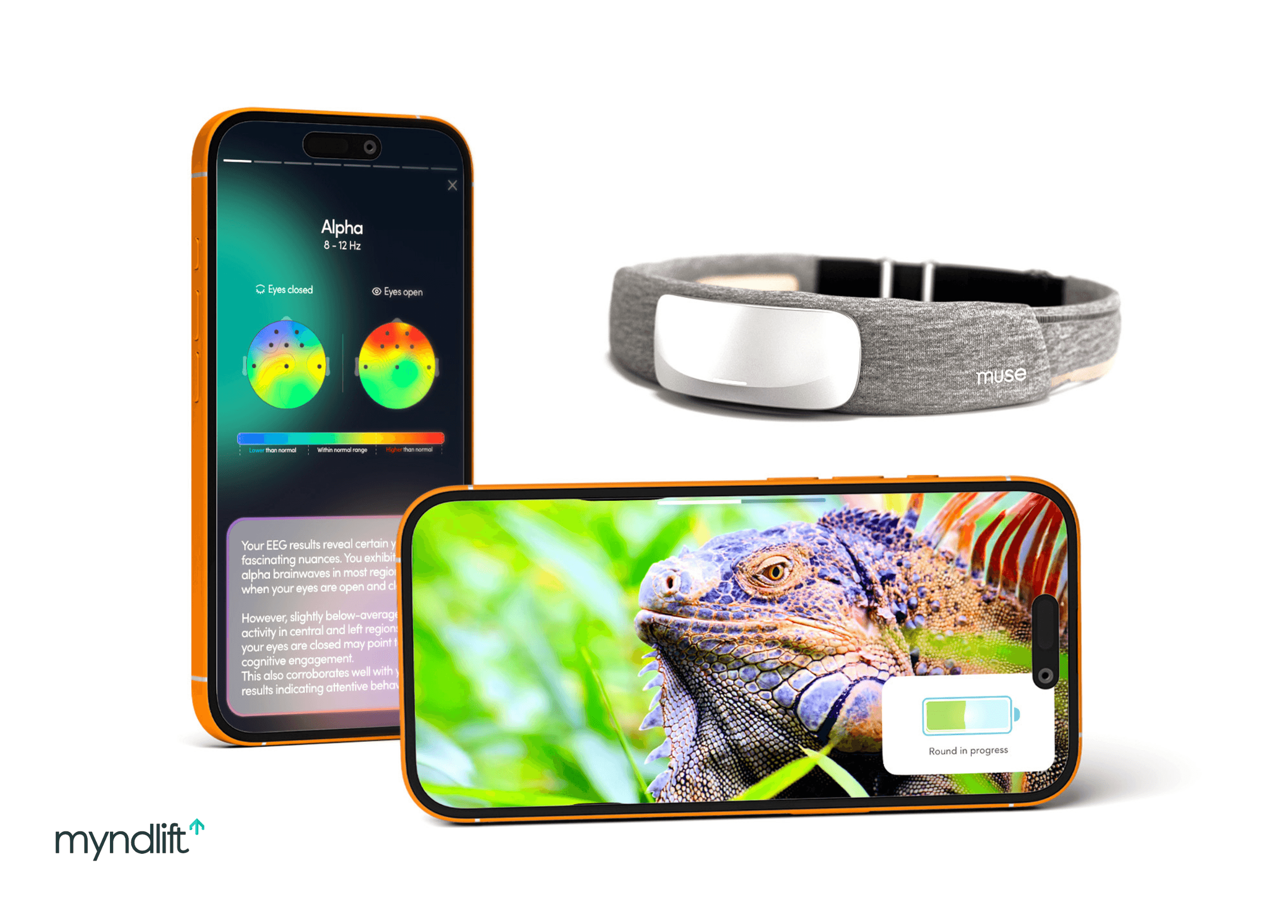

Myndlift now supports fNIRS-enhanced neurofeedback with the Muse S Athena.
During a session, you can get feedback from two signals at once. EEG picks up your brain’s electrical activity, while fNIRS tracks changes in blood oxygenation near the front of your brain.
For you, the most noticeable change is a subtle cue at the edges of your screen.
Here’s what that cue means and how it fits into your training.
What fNIRS adds to EEG training
EEG is the foundation of Myndlift training. It measures your brain’s electrical activity, which changes by the millisecond, and that speed is what makes real-time feedback possible.
fNIRS (functional near-infrared spectroscopy) measures something different: blood oxygenation in the prefrontal cortex, an area involved in attention and self-control.
When a brain area becomes more active, blood flow to it increases.
Oxygen-rich and oxygen-poor blood absorb near-infrared light differently, so fNIRS can track those changes by shining light through your forehead.
Because blood flow takes a few seconds to respond, this signal shifts more slowly than EEG.
Together, the two signals give your Neuro Coach more to work with. For example, if your EEG signal regularly hits its target, your coach can check whether your oxygenation signal follows the same pattern. That extra detail helps them fine-tune your plan as you go.
What you’ll notice during a session
Myndlift sessions give you feedback as you train, through sound, visuals, or haptics, whichever suits you.
With fNIRS, there’s a second layer. When your oxygenation signal hits its target, soft cues light up around the edges of your screen.
They’re subtle by design, so they let you know you’re on track without pulling you out of the moment.
More ways to train with Myndlift
fNIRS is one of several recent updates to Myndlift. Here’s what else you can do:
Harmonia: Train with music that adapts to your brain in real time. No screen needed, just press play.
Brain Snapshots: Take a 3-minute scan before and after coffee, a workout, or supplements, then compare two scans side by side with an AI summary of what changed.
Alpha-theta training: Close your eyes and let your brainwaves shape the sound as you settle into deep relaxation.
3D feedback: Get feedback through sight, sound, and touch at once, so you stay present throughout your session.
Most Myndlift members train with a Neuro Coach who builds and adjusts their plan. If you’d rather go at your own pace, there’s also a self-guided option.
See everything that’s new →
What you’ll need for fNIRS training
All you need is a Myndlift app and a Muse S Athena headband, which has both EEG and fNIRS sensors built in. If you already have another compatible Muse headband, you can still train with Myndlift using EEG.
Want to try fNIRS neurofeedback at home? With Myndlift, you can train with EEG and fNIRS in the same session. Take the eligibility check to see if you can get started.
FAQs
Will I still get EEG feedback during an fNIRS-enhanced session?
Yes. EEG remains the foundation of your session, and fNIRS adds a second feedback cue alongside it.
What does it mean when the fNIRS cue appears?
It means the signal reached the target range for that session. The cue tells you something specific about that moment in training. On its own, it can’t tell you how focused you were or assess your overall brain health.
Will adding fNIRS change my results?
Results vary from person to person. The immediate change is an extra feedback cue during training and an additional signal your Neuro Coach can review.
Related posts