
Updated: September 3, 2026
The at-home neurofeedback systems compared here are Myndlift, Muse, Sens.ai, Mendi, Neurosity Crown, FocusCalm, and Neurable, spanning guided neurofeedback, self-directed training, and cognitive tracking.
“At-home neurofeedback” covers different technologies: EEG measures electrical brain activity, while fNIRS measures changes in blood oxygenation and blood flow. Some newer systems combine multiple sensing or training modalities.
A brain-sensing headset and a neurofeedback system aren't the same thing. A complete system can add assessments, training protocols, progress tracking, and professional guidance.
The biggest practical distinction is personalized vs. fixed training. Some systems adapt protocols based on assessments and progress, while others provide the same predefined training experience to every user.
If you're comparing at-home neurofeedback systems, you've probably hit a wall of spec sheets that all start to blur together.
Some of what's on this list are devices, the hardware that reads your brain activity. Others are complete neurofeedback systems: hardware plus the software, protocols, and support built around it.
What actually shapes your day-to-day experience is how the training gets personalized to you, whether you can tell if it's working, what support is there when something's unclear, and what the sessions feel like after a dozen uses.
We compared seven of the more established options, Myndlift, Muse, Sens.ai, Mendi, Neurosity Crown, FocusCalm, and Neurable on those points, so you can see what you're signing up for.
At a glance
If you want to… | Consider | Why | Training Type | Price |
Alleviate ADHD symptoms, anxiety, improve sleep, or reach peak performance with expert support | Myndlift | Training plans adjust based on your data and a coach's input | Custom 3D – Visual, Auditory, Haptic, EEG, and fNIRS | Starts at $249 for the kit, plus subscription |
Build a daily meditation practice that helps you relax and sleep better | Muse | Designed around mindfulness and sleep | Fixed protocols, EEG and fNIRS | Starts at $249 for the device, with an optional subscription |
Try multiple training modalities in one system | Sens.ai | Combines EEG, HRV, and light therapy | Custom,EEG and PBM (stimulation) | $1,500 |
Improve focus and stress management, but start cheap and simple | Mendi | Lowest barrier to entry, minimal setup | Fixed, fNIRS | $299 |
Track focus while you work | Neurosity Crown | Built for continuous background tracking, not standalone sessions | Fixed, adaptive feedback | $1,499 |
Dip a toe into EEG training | FocusCalm | Bare-bones hardware, no long-term commitment needed | Fixed, EEG | $309.99 for the headband, plus a subscription |
Track mental fatigue throughout your day | Neurable | EEG built into everyday headphones | Fixed, EEG | $499 |
Also considering in-clinic options? Compare the best in-clinic and remote neurofeedback systems →
1. Myndlift
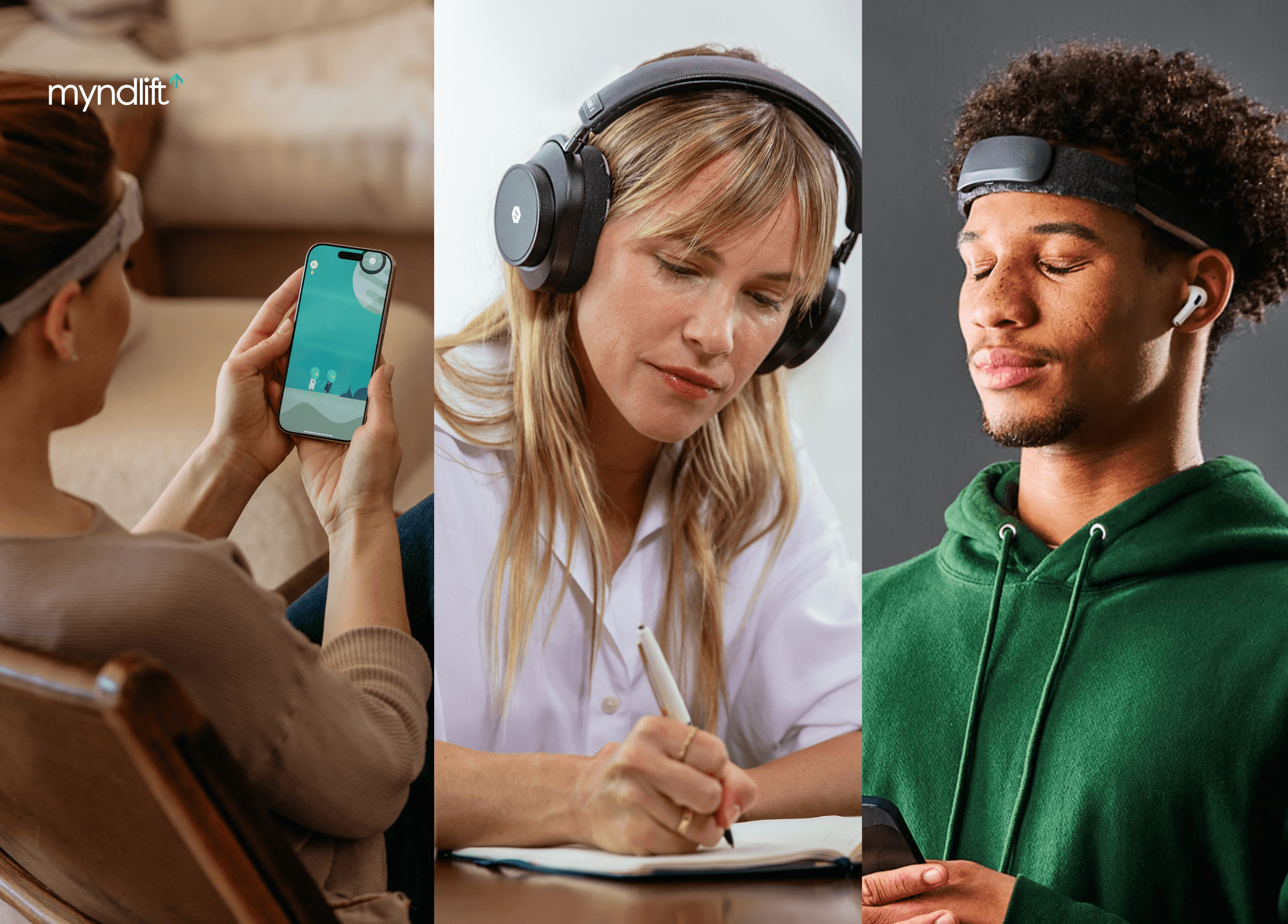
The neurofeedback process starts with brain and cognitive assessments, not a generic default protocol.
It's the only system in which you work with a dedicated expert, a Neuro Coach who reviews that data, builds your training plan, and adjusts it as your brain changes over sessions, so the program you're running in week six isn't the one you started with.
Training can run alongside Netflix, Hulu, or YouTube, or completely screen-free using audio feedback. The platform also includes clinician-facing software for mental health professionals using neurofeedback with clients.
Best for: individuals or clinics seeking guided, data-driven neurofeedback with proven clinical reliability.
Less suitable for: DIY tinkerers or ultra-budget, self-serve seekers.
Price: starts at $249 for the kit, plus subscription. For clinics: starts at $2,990 with full onboarding and integration.
Because it’s compatible with all Muse models, you get access to both the capabilities of the Muse app and the Myndlift app in one package.
2. Muse
Muse 2 and the newer Muse S Athena use EEG neurofeedback for focus and mindfulness training and track cognitive performance over time.
Muse S Athena adds fNIRS for tracking blood oxygenation in the prefrontal cortex and training mental effort and endurance, along with more advanced sleep features.
With Premium, users get cognitive performance and recovery tracking, an AI coach, external audio, and 500+ guided sessions. Muse is primarily self-directed, but the hardware is also compatible with systems such as Myndlift for more personalized, professionally guided neurofeedback.
Best for: people who want self-directed neurofeedback for focus, mindfulness, cognitive tracking, and sleep.
Less suitable for: users seeking individualized protocols and professional oversight.
Price: Muse 2 starts at $249.99; Muse S Athena at $474.99, with an optional Premium subscription.
3. Sens.ai
Sens.ai combines EEG, heart-rate variability, and photobiomodulation (light-based stimulation) into one headset, with built-in headphones for an immersive, guided-journey training experience.
The price is steep for most, but the range of what's happening in a single session, light stimulation, heart and brain tracking, and binaural beats together, is what justifies it.
It's built for someone who wants to explore how those modalities interact, not follow one clear guided path from a coach.
Best for: advanced biohackers wanting multimodal, structured performance journeys.
Less suitable for: beginners or anyone needing a simple setup or clinical oversight.
Price: $1,500.
4. Mendi
Mendi is lightweight and uses functional Near-Infrared Spectroscopy (fNIRS) to detect changes in blood flow and oxygenation in the prefrontal cortex, the area tied to focus and decision-making.
It turns that signal into a short daily game you play to build focus.
The game does respond to your real-time signal each session, but there's no upfront brain assessment and no protocol built from your data the way assessment-driven systems offer, you start with a guided ramp-up (a few short sessions in week one) and increase from there.
Best for: price-conscious newcomers.
Less suitable for: users wanting EEG-based, customizable, clinic-grade programs built around an assessment.
Price: $299.
5. Neurosity Crown
Neurosity isn't a sit-down neurofeedback system, it's designed to run in the background while you're already working or studying.
It uses eight dry-contact EEG channels to track attention and shifts adaptive music in real time based on your brain state, and developers can pull the raw data through an open SDK to build their own applications on top of it.
There's no assessment step and no protocol that adjusts to you over time the way a coached system does, it's continuous tracking and real-time nudging rather than a structured training arc.
Best for: productivity hackers and developers who want focus tracking and API flexibility.
Less suitable for: those seeking simplicity or traditional, structured neurofeedback.
Price: $1,499, one-time purchase, no subscription.
6. FocusCalm
FocusCalm's headband offers a price-friendly way to jump into brain training, similar to Mendi and Muse.
It uses a simpler EEG setup than multi-channel systems, limiting the number of scalp locations it can measure simultaneously, but the app makes up for it with guided meditations, gamified brain-training sessions, and structured programs rather than just a single loop.
It's designed to be used eyes-open, so there's no dedicated meditation posture or quiet room required.
There's no assessment or clinician layer behind it, it's a low-friction way to see what EEG feedback feels like before deciding whether to go further.
Best for: price-conscious newcomers.
Less suitable for: users seeking high-resolution training, or those seeking professional neurofeedback.
Price: $309.99 for the headband, plus a subscription ($9.99/mo, $69.99/yr, or $189.99 lifetime).
7. Neurable
Neurable, in partnership with audio brand Master & Dynamic, builds EEG sensors directly into the earpads of premium noise-cancelling headphones, the current model is the MW75 Neuro LT.
That means your brain activity gets measured inconspicuously during everyday use, which most EEG devices can't manage given how impractical it is to wear a dedicated headband all day.
The sound quality is genuinely high-end, and the app layers cognitive tracking, like a quick "readiness" check and fatigue alerts, on top of that.
Best for: casual, all-day cognitive tracking in premium headphones.
Less suitable for: users seeking structured neurofeedback training or specific health outcomes.
Price: $499 (MW75 Neuro LT).
How to choose a system
Cutting through all of the above, it comes down to four questions:
Do you want a Neuro Coach involved, or are you training solo? The bigger difference is what happens when the training isn't working as expected. With expert-guided systems, a professional can review progress and adjust the protocol, while self-directed ones leave those decisions to the software or the user. Sens.ai sits somewhere in between, with adaptive, multimodal training but no clinician guiding it.
What are you actually trying to change? General goals like meditation, focus, or relaxation don't necessarily require an assessment-driven system. If you're targeting specific symptoms or performance goals, baseline assessments and progress tracking become more relevant because the training can be built around what you're trying to change.
What kind of feedback will keep you training? This is more useful than dedicated vs background IMO. Some systems turn brain activity into games, some use audio or video, and others simply track cognitive states while you work. The feedback loop is what you'll experience every session, so it's worth choosing one you can realistically stick with.
Compare the program cost, not just the hardware. A $299 neurofeedback device with lifetime access and a $249 headband tied to subscriptions aren't really $50 apart. Factor in software, professional support, accessories, and the time you expect to spend training before comparing prices.
The bottom line
"Neurofeedback device" and "neurofeedback system" get used like they mean the same thing, but they don't.
A device reads your brain. A system reads it, then does something with what it finds, adjusts, coaches, and builds a plan around your goals.
That's the question to ask before you buy: are you getting the hardware, or the hardware plus everything that makes it actually work for you?
FAQs
Do I need a qEEG brain map before doing neurofeedback at home?
You don't need a qEEG to do neurofeedback at home; many consumer devices let you start training immediately. A qEEG measures resting brain activity across multiple scalp locations and compares it with reference data, providing a more detailed baseline that can guide individualized protocol selection and track changes over time. In more comprehensive systems, it can be combined with questionnaires and cognitive testing to build a fuller picture before training begins.
What’s the difference between Muse and Myndlift?
Muse is both an EEG headset and a consumer platform primarily focused on meditation, sleep, and mindfulness. Myndlift uses compatible Muse hardware as part of a more comprehensive neurofeedback system. With Myndlift, EEG data is used alongside assessments to create an individualized training plan, with a Neuro Coach monitoring progress and adjusting the protocol over time. Myndlift also supports an external EEG electrode, allowing training from additional scalp locations beyond the sensors built into the Muse headband.So while the hardware can be the same, the training experience and how the EEG data is used are different.
How long does it take to see results from neurofeedback?
Early, inconsistent changes often appear between sessions 5 and 10. More stable, noticeable patterns tend to emerge between sessions 10 and 20.
Can neurofeedback make you feel worse?
It can temporarily. Reported effects include fatigue, headaches, dizziness, brain fog, difficulty concentrating, or feeling unusually wired or anxious. The response can depend on the protocol: training faster frequencies may leave some people more alert or make it harder to wind down, while slower-frequency training may cause fatigue or fogginess. These reactions are generally reported as mild and temporary. If they persist or worsen, the training may need to be adjusted, which is one reason the ability to change the protocol based on how someone responds matters when comparing neurofeedback systems.
Can you do neurofeedback at home without a professional?
Yes, but there are two quite different versions of "at-home neurofeedback." Some devices are entirely self-directed: you put on the headband, open the app, and follow a predefined training experience. Other remote systems combine the convenience of home training with professional oversight. The latter is closer to how neurofeedback has traditionally been delivered: someone can use assessment data to determine what to train, monitor the response, and adjust the protocol when necessary. If personalization and progress monitoring matter to you, professional involvement is therefore worth considering when comparing systems.
Related posts