
There's a state most people pass through for only a few seconds each night, right as they drift from wakefulness into sleep.
It's where thoughts begin to loosen, mental chatter quiets, and dreamlike imagery starts to appear. Then sleep takes over, and the moment is gone.
Alpha-theta neurofeedback is designed to help the brain spend more time in that transitional state instead of passing through it.
Many clinicians use this approach because the state is associated with deep relaxation and is thought to make it easier to access emotions and internal imagery than during ordinary waking consciousness.
For that reason, alpha-theta training has long been incorporated into some trauma-focused and addiction recovery protocols, as well as sessions aimed at promoting deep relaxation.
It's one of the oldest neurofeedback approaches, with decades of clinical use. It's now available to clinicians through Myndlift, a platform for delivering neurofeedback in person and remotely.
What is alpha-theta neurofeedback training?
The name comes from the two brainwave patterns that become increasingly prominent as the brain approaches that state: alpha and theta.
Alpha (8–12 Hz) is associated with relaxed wakefulness: eyes closed, calm, not actively problem-solving.
Theta (4–8 Hz) is more prominent during drowsiness and light sleep, and is linked to the dreamlike, image-rich thinking that often appears at the edge of sleep.
Traditionally, “alpha-theta crossover” describes a shift in which theta activity increases relative to alpha as the client moves toward the target state.
Different implementations may define and detect this shift differently. In Myndlift, crossover is detected using the theta-to-alpha ratio rather than requiring the raw theta amplitude to literally overtake alpha.
Who is it for?
Most of the clinical interest traces back to the Peniston-Kulkosky protocol, developed in the late 1980s for alcohol dependence.
Its early findings brought widespread attention to Alpha-Theta training, particularly in addiction recovery and later in trauma-focused care.
Clinicians most often reach for it in:
Addiction and recovery, the original use case
Trauma and PTSD, often alongside EMDR or somatic work rather than in place of it
Anxiety and deep relaxation
Peak performance, where the goal is a calm, absorbed, flow-adjacent state
Clinical tip
"For a peak performance client with no trauma history, it matters much less whether you rotate it with other protocols or run it exclusively." Ursa Davis, LPC, NCC
What does alpha-theta training feel like?
Every experience is different, but clients often describe feeling deeply relaxed while remaining aware of their surroundings.
Some notice vivid mental imagery, memories, emotions, or creative thoughts surfacing as their minds become quieter.
Others simply feel calm or drowsy, with little happening beyond a sense of relaxation. Neither experience is considered necessary for the training to be effective.
Unlike hypnosis, clients aren't "put under" or guided through suggestions. They remain conscious throughout the session while the brain gradually shifts into this deeply relaxed state in response to the neurofeedback.
Why this state matters
One theory is that alpha-theta temporarily shifts the brain away from analytical, goal-directed thinking and toward a more associative mode of processing.
Some clinicians believe this makes it easier for clients to engage with difficult emotional material while remaining grounded, although the exact mechanisms are still being studied.
Clinical tip
"Some clients with severe developmental trauma do Alpha-Theta and feel only benefits, while others become triggered or agitated. Assume the latter and start gently." Ursa Davis, LPC, NCC
Some researchers have proposed that it may facilitate processes such as memory reconsolidation, but this remains a hypothesis rather than an established mechanism.
Using Alpha-Theta Crossover in Myndlift
Myndlift allows clinicians to deliver Alpha-Theta Crossover remotely or in the clinic.
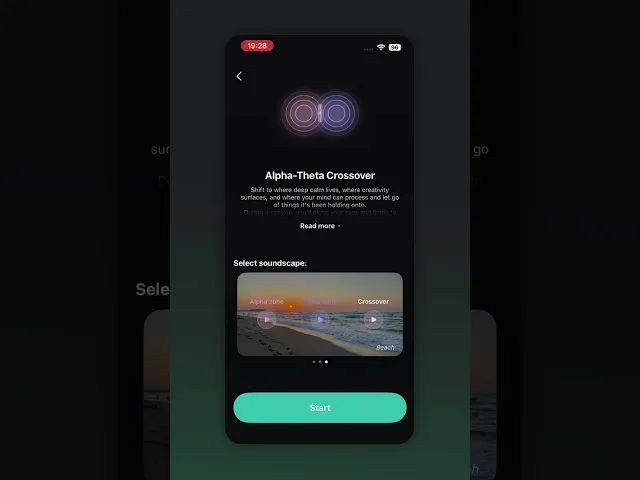
During the session, the client reclines with their eyes closed and listens to a soundscape of their choice.
One sound is linked to alpha and another to theta.
As each brainwave reaches its target, its corresponding sound becomes louder. When the theta-to-alpha ratio crosses the target threshold, a gong sounds, marking a detected crossover event.
Because theta naturally varies from person to person, the crossover isn't defined as theta simply becoming stronger than alpha.
Instead, Myndlift measures the theta-to-alpha ratio, allowing the protocol to detect a meaningful shift regardless of the client's baseline brain activity.
Built-in safeguards also help prevent the gong from sounding if the client falls asleep or if poor EEG signal quality affects the measurement.
Sessions typically last around 20–30 minutes.
Looking beyond Alpha-Theta
Alpha-theta is just one of many approaches available to clinicians. Choosing when to use it is often easier when you can look beyond a single session and consider the bigger picture.
Myndlift combines qEEG brain assessments, cognitive testing, symptom questionnaires, and ongoing training client information in one place.
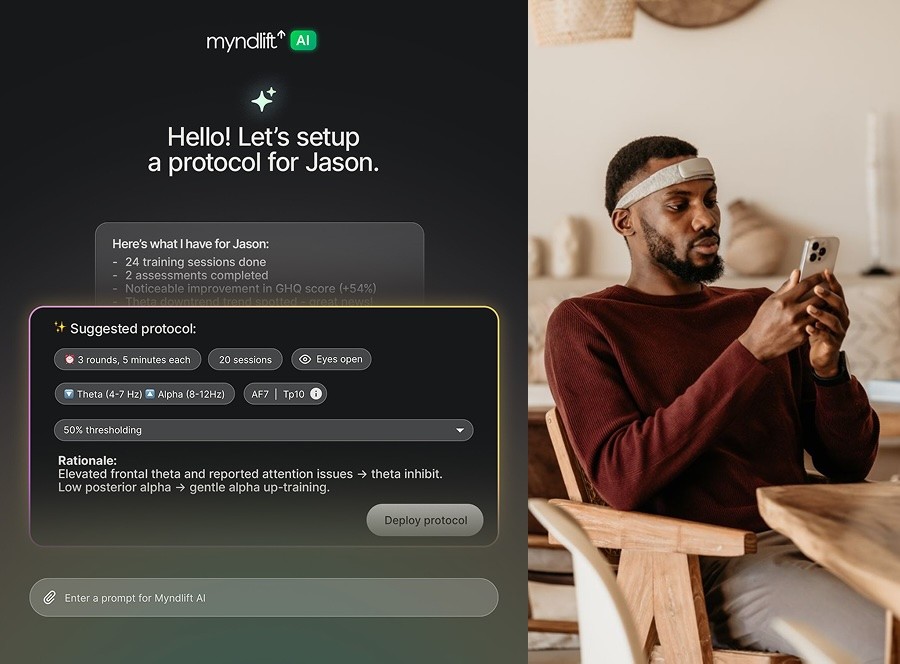
The AI Clinical Assistant can review this information, surface clinically relevant patterns, and suggest protocols to consider, giving you another perspective alongside your own clinical judgment.
The skill isn't the protocol
Alpha-theta rewards clinicians who know exactly why they're reaching for it.
The state it produces is powerful and non-specific, so the skill isn't in running the protocol; it's in choosing the client, setting the expectation, and reading the response.
Get those right, and it earns its place in the toolkit.
Myndlift gives clinicians data-driven neurofeedback and better client outcomes, from qEEG and CPT to protocol deployment and remote monitoring, in one dashboard. Schedule a demo to see how clinics are running alpha-theta today.
FAQs
Can I add alpha-theta to a client's existing protocol?
You can run it as a standalone track or fold a weekly session into existing work. Because it targets a different state from most focus or anxiety protocols, use your clinical judgment about what the client's current targets can absorb, and review how they respond before making it routine.
What does the client see in the app during this protocol?
Only the specialized audio session. Other activities like YouTube and streaming are hidden, since they don't fit an audio-only, eyes-closed protocol. Clients who want those formats switch back to a standard protocol.
How is a "crossover" defined?
As the theta/alpha ratio passing a set threshold, not theta literally overtaking alpha. In practice it usually reflects a significant rise in theta while alpha stays relatively stable. A gong marks the moment it happens.
What stops the gong from firing if a client falls asleep?
Built-in guardrails. They prevent the gong from triggering due to sleep onset or signal noise skewing the ratio, so the marker stays meaningful.
How do I deploy it?
Find it in the protocol deployment menu under the "Specialized" tag, or ask Myndlift’s AI Clinical Assistant to deploy it for you.

References
Peniston EG, Kulkosky PJ. Alpha-theta brainwave training and beta-endorphin levels in alcoholics. Alcohol Clin Exp Res. 1989 Apr;13(2):271-9. doi: 10.1111/j.1530-0277.1989.tb00325.x. PMID: 2524976
Sokhadze, T.M., Cannon, R.L. & Trudeau, D.L. EEG Biofeedback as a Treatment for Substance Use Disorders: Review, Rating of Efficacy, and Recommendations for Further Research. Appl Psychophysiol Biofeedback 33, 1–28 (2008). https://doi.org/10.1007/s10484-007-9047-5
Askovic M, Soh N, Elhindi J, Harris AWF. Neurofeedback for post-traumatic stress disorder: systematic review and meta-analysis of clinical and neurophysiological outcomes. Eur J Psychotraumatol. 2023;14(2):2257435. doi: 10.1080/20008066.2023.2257435. Epub 2023 Sep 21. PMID: 37732560; PMCID: PMC10515677
Dinc L, Rybski D, Dineen J. The effects of alpha/theta neurofeedback on mood, anxiety, emotion regulation and trait impulsivity. Brain Res. 2025 Nov 1;1866:149943. doi: 10.1016/j.brainres.2025.149943. Epub 2025 Sep 11. PMID: 40945564
Gruzelier J. A theory of alpha/theta neurofeedback, creative performance enhancement, long distance functional connectivity and psychological integration. Cogn Process. 2009 Feb;10 Suppl 1:S101-9. doi: 10.1007/s10339-008-0248-5. Epub 2008 Dec 11. PMID: 19082646
Related posts