
Last updated: August 28, 2026
Gold-standard home neurofeedback programs run in five steps: brain assessment, personalized plan, at-home training, progress tracking, and protocol adjustments as your brain adapts
Most sessions take around 20 to 30 minutes, done several times a week, and can happen while you stream shows, play games, or listen to music
People begin noticing meaningful changes with consistent training, though the first signs are often subtle and get spotted by friends or family before you notice them yourself
This guide covers how remote neurofeedback works, what a session looks like, what the research shows, and how to know if it's the right fit for you
When Netflix released Quarterback, one scene stood out to many viewers. Between games, NFL quarterback Kirk Cousins sat in his car wearing an EEG headband, training his brain with a home neurofeedback platform.
A few years ago, that would have been unusual.
Neurofeedback was largely limited to specialized clinics, requiring regular appointments and in-person supervision.
Today, advances in remote neurofeedback have made it possible to do brain training from home, while some programs include guidance from a Neuro Coach or clinician.
How does home neurofeedback work?
Home neurofeedback is a form of brain training that uses EEG sensors to measure your brain activity in real time.
During a session, EEG electrodes in the headband sit against your scalp and detect tiny voltage changes produced by groups of neurons. The system processes that electrical activity into frequency patterns, commonly described as brainwave bands, such as theta, alpha, and beta.
Each band is associated with different mental states: alpha with relaxed alertness, beta with active focus, and theta with drowsiness or inward attention, for example.
How your brain receives feedback
Software analyzes these patterns in real time and provides immediate visual, haptic, or auditory feedback.
When your brain produces the target activity, the feedback rewards it: a sound becomes more pleasant, a game progresses, a video plays more smoothly. When it drifts away, the feedback changes.
This process is a form of operant conditioning: the brain learns which mental states produce the reward and gradually becomes better at accessing them. Over repeated sessions, this feedback helps your brain practice healthier patterns of activity.
Unlike meditation or mindfulness, neurofeedback doesn't ask you to consciously control your thoughts. Your brain gradually learns through repetition, much like improving balance or coordination through practice.
“What really makes home neurofeedback special is the flexibility. With in-clinic sessions, you’re often locked into a time. Say, next Tuesday at 4 PM. With home neurofeedback systems, you can do a session when you actually need it. Feeling overwhelmed in the middle of the day? You can open the app and do a quick session right then and there”, explains neurofeedback expert Dr. Daryl Lytle.
NFL quarterback Kirk Cousins training his brain with Myndlift, an at-home neurofeedback platform
What does a home neurofeedback program look like?
While every home neurofeedback system is different, clinician-guided programs generally follow the same five-step process.
1. Complete a brain assessment
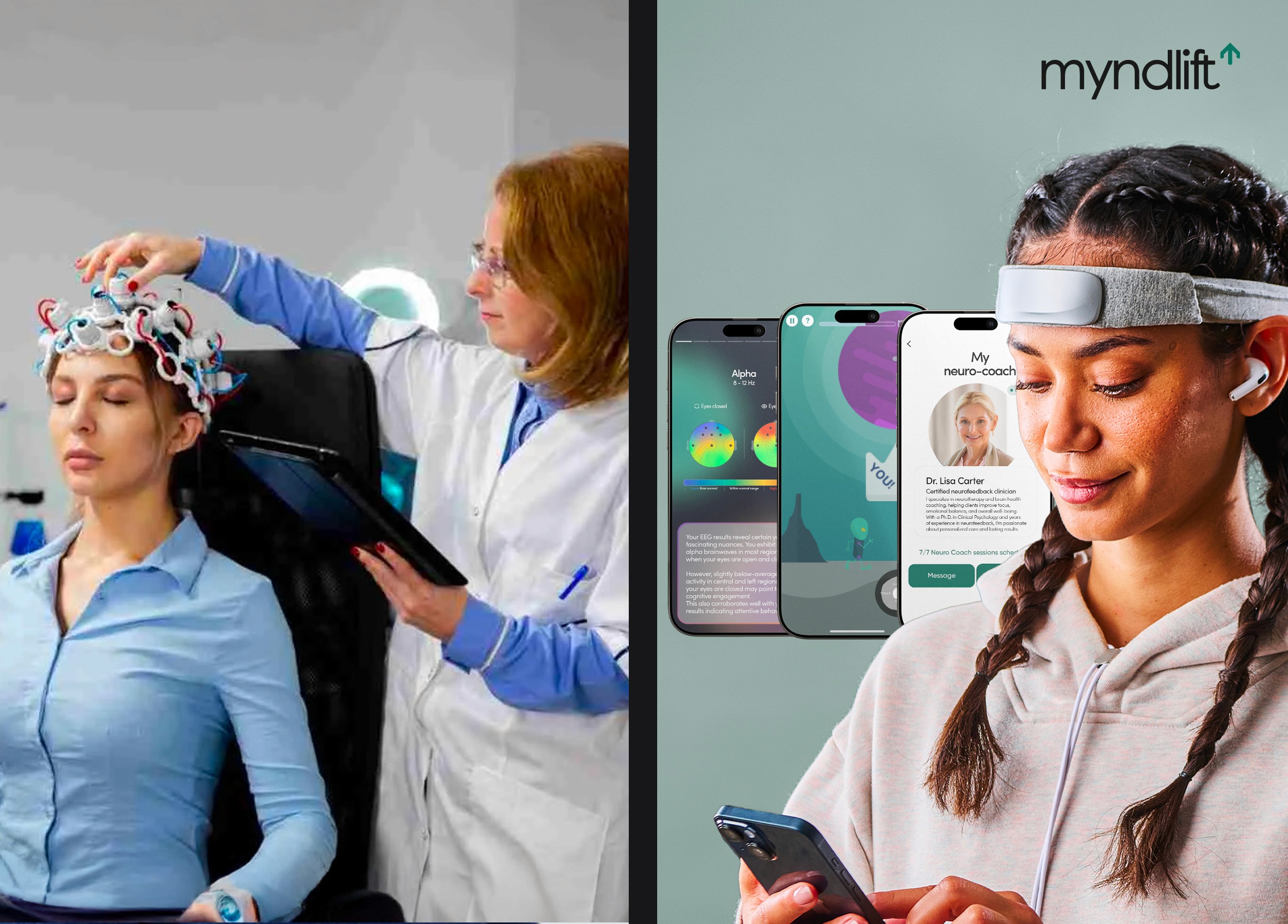
Before training begins, you'll complete an assessment to establish a baseline. Depending on the platform, this may include questionnaires, cognitive tests, and EEG measurements to better understand your symptoms, goals, and current brain activity.
This information helps determine which brain patterns may benefit most from training.
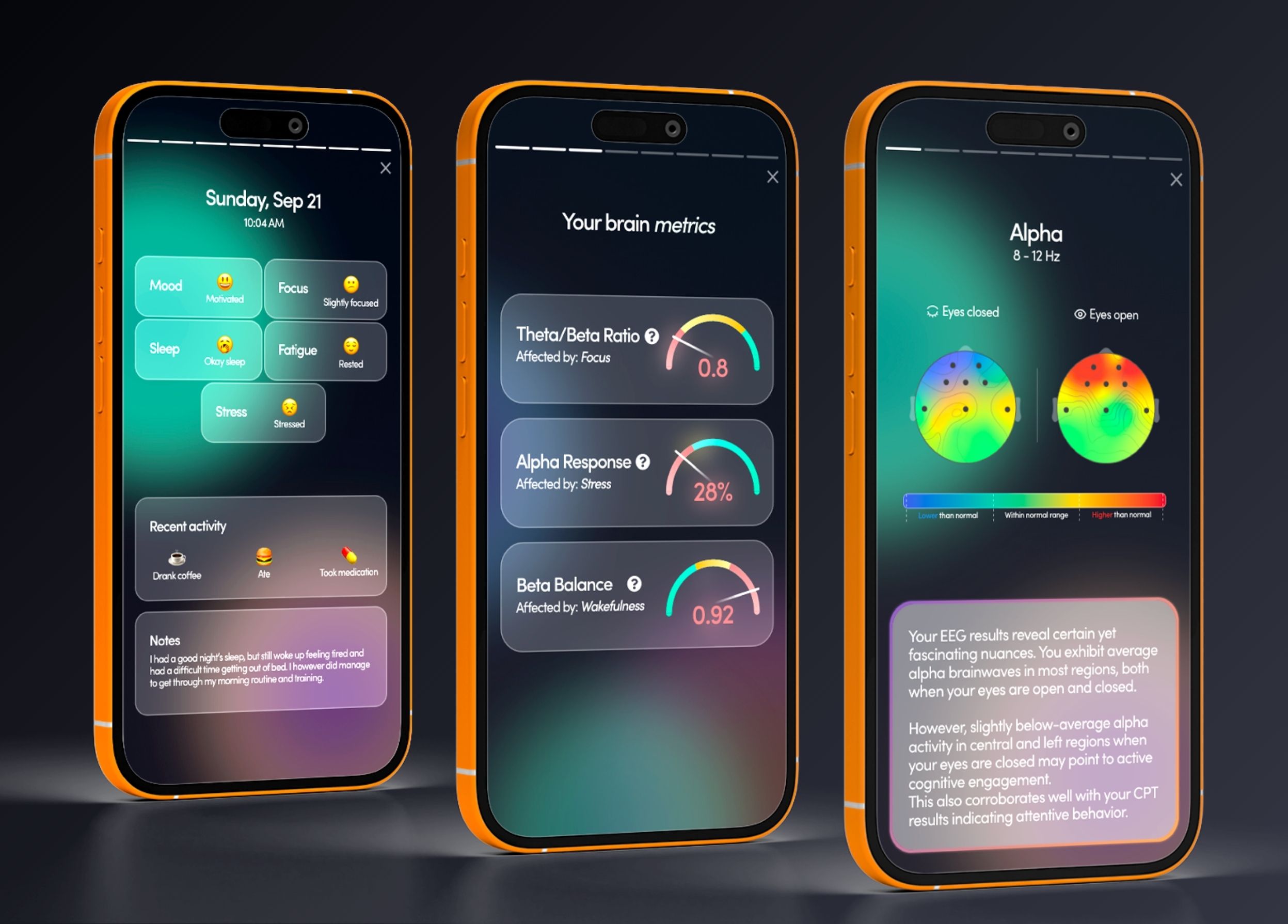
Metrics inside the Myndlift platform
2. Receive a personalized training plan
Based on your assessment, a Neuro Coach or clinician creates a personalized neurofeedback training plan.
Rather than using the same protocol for everyone, clinician-guided platforms tailor training to your goals, whether you're looking to improve focus, reduce anxiety, sleep better, or enhance cognitive performance.
3. Train your brain at home
Using an EEG headset and a neurofeedback app, you'll complete regular training sessions from home. Most sessions last around 20 to 30 minutes, and many programs recommend training several times per week for the best results.
Depending on the platform, you may train through interactive games, videos, music, or even while streaming your favorite shows.
As your brain produces the desired activity, the software provides real-time feedback, gradually reinforcing healthier brainwave patterns.
4. Track your progress
As you continue training, your progress is monitored through session data, follow-up assessments, symptom tracking, or repeat brain assessments.
Tracking progress helps determine whether your current protocol is working and provides an objective way to measure improvements over time.
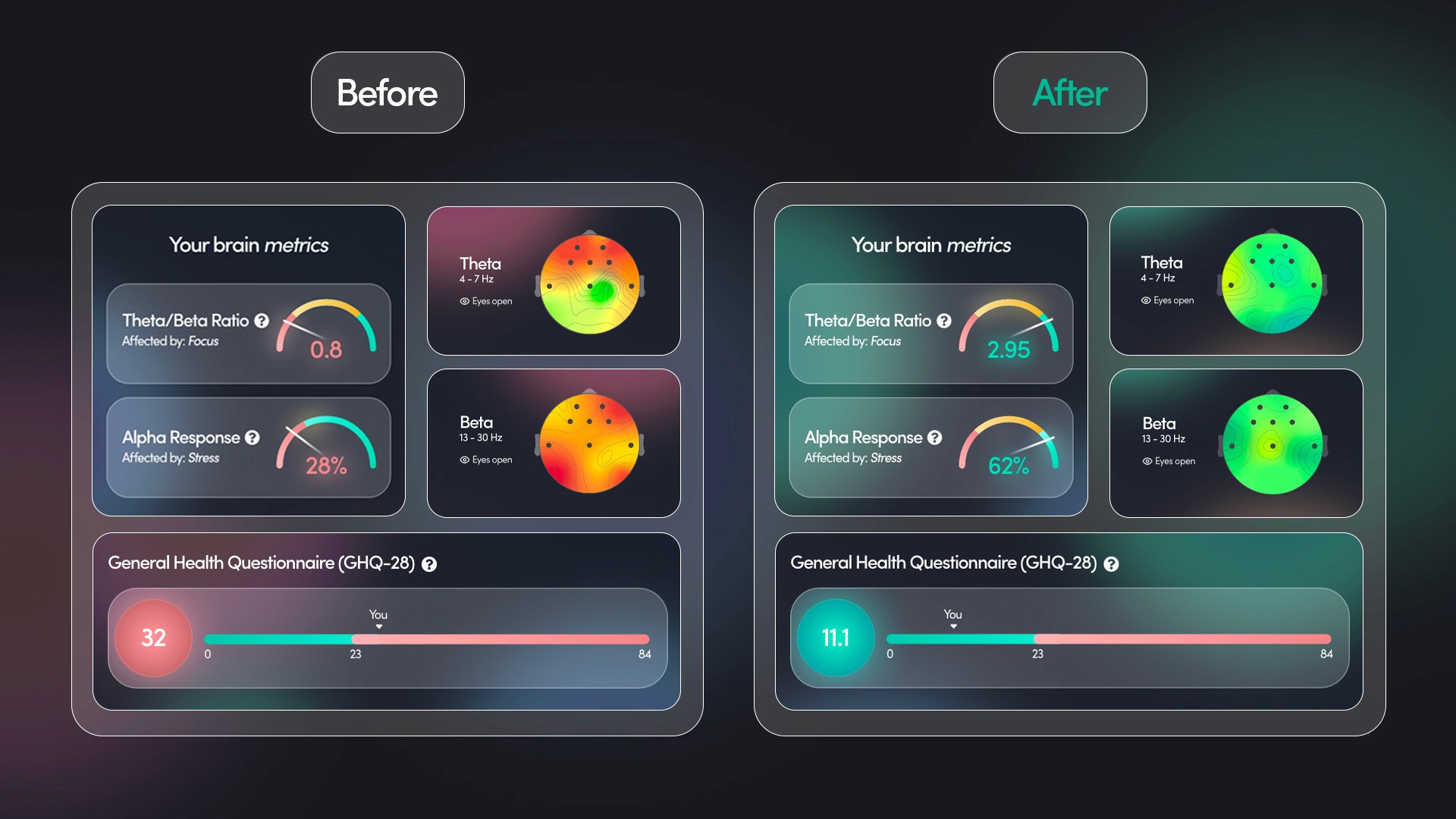
Before and after neurofeedback metrics shown inside the Myndlift app
5. Adjust your training
Your brain changes as it learns, so your neurofeedback program should evolve as well.
In clinician-guided home neurofeedback programs, your Neuro Coach reviews your progress and adjusts your training protocol when needed to help you continue moving toward your goals.
Does home neurofeedback work?
One of the biggest questions people have is whether neurofeedback can be just as effective at home as it is in a clinic. The evidence depends heavily on the type of program.
Research reviewing consumer neurofeedback used alongside mindfulness found modest reductions in psychological distress compared to controls, but did not find convincing improvements in cognition, physiological health, or reliable evidence that participants were modulating the targeted brain activity.
The researchers noted that more extensive calibration and individualization of devices may improve outcomes.
That finding points to something Myndlift is built around: the difference between a fixed, self-guided program and one that begins with a brain assessment, is personalized to your brain activity and goals, and adapts based on how you respond.
A peer-reviewed study of Myndlift's remote neurofeedback platform found that participants showed significant improvements in mental health and cognitive functioning following consistent, personalized training.
"In terms of results, there are usually two kinds: immediate and longer-term. Some people feel something during the session itself, like feeling calmer or more focused right away. Others don't notice much in the moment, but after a few weeks, they start to feel different in their day-to-day lives. In many cases, it's not just the person who notices; it's their friends, family, or coworkers who say, 'You seem different, in a good way,’ explains Dr. Lytle.
Most people begin noticing meaningful improvements within 3–6 weeks of consistent training, although the timeline varies depending on the individual, their goals, and the type of neurofeedback program they follow.
Like any form of training, the best results come from consistency and a personalized approach that adapts as your brain changes.
What equipment do you need for home neurofeedback?
Most systems require just two pieces of equipment, an EEG headset and neurofeedback software, plus, depending on the platform, guidance from a clinician or Neuro Coach
1. An EEG headband
During each training session, EEG headband sensors detect your brainwaves and send that information to the neurofeedback software in real time.
Home neurofeedback platforms such as Myndlift are compatible with the Muse 2 and Muse S Athena EEG technology. These wireless devices are designed for home use, so setup takes minutes.
2. Neurofeedback software
The software is where your training takes place. It receives data from your EEG headset, analyzes your brain activity, and provides real-time feedback through games, videos, music, or other interactive experiences.
Most platforms also let you track your progress over time, complete assessments, and review previous training sessions.
3. Professional guidance (optional but important)
Consumer EEG headbands typically use a small number of electrodes positioned around the forehead and ears. That's enough to detect broad brain activity, but the signal is vulnerable to interference from eye movements, muscle tension, and physical movement.
Without filtering, calibration, and a trained eye interpreting the results, the data can be noisy and difficult to act on meaningfully.
This is one reason why two products using the same EEG hardware can deliver very different experiences.
The headband is the sensor. What determines the quality of the program is what happens to the brain data afterward: whether the user receives an assessment before training begins, whether the protocol is personalized to their brain activity and goals, and whether someone with expertise is monitoring their progress and adjusting the plan as their brain adapts.
Some platforms are entirely self-guided, using pre-built training programs with little or no personalization. Others, like Myndlift, pair the technology with a dedicated Neuro Coach who reviews your assessment, builds an individualized plan, and adjusts it based on how you respond over time.
Who can benefit from remote neurofeedback?
Neurofeedback has shown efficacy in alleviating symptoms of anxiety, depression, ADHD, sleep disorders, addiction, and chronic pain.
It can also help with improving overall wellbeing by promoting relaxation, reducing stress, and even enhancing physical performance.
As Dr. Lytle explains, if your brain becomes more mentally flexible, you're simply going to function better overall, whether it's at work, at school, or in everyday life:
“Whether someone is dealing with a clinical concern or just looking to sharpen their thinking and performance, neurofeedback can support that by helping the brain operate more efficiently and adaptively”.
It’'s important to note that even though neurofeedback has great potential for alleviating certain symptoms and improving wellbeing, it should not be used as a substitute for medical treatment or therapy. For proper diagnosis and treatment, it's crucial to consult with a licensed medical professional.
For proper diagnosis and treatment, it's crucial to consult with a licensed medical professional.
See if it's a fit
Neurofeedback has been around for decades, but it used to mean booking appointments and sitting in a clinic. That's changed.
Now you can train your brain from the couch, from your car, or in bed before you fall asleep, with an expert still in your corner when you need one. It's the same science, just built to fit into a normal day.
If you want to do remote neurofeedback with Myndlift:
Take our 10-second quiz to find your personalized, human-guided neurofeedback program.
If you're a clinician:
Myndlift helps practices deliver data-driven care with measurable outcomes. Schedule a demo and see how it works in practice.
FAQs
Does home neurofeedback really work?
The evidence depends on the type of program. Research on generic consumer neurofeedback has shown modest benefits for psychological distress, but limited effects on cognition or physiological health when programs lack personalization. Clinician-guided platforms that begin with a brain assessment and adapt the protocol over time show more consistent results. Peer-reviewed research on Myndlift's remote platform found significant improvements in mental health and cognitive functioning with consistent, personalized training.
Is home neurofeedback safe?
Yes. Neurofeedback is non-invasive; the sensors only read your brain's activity, they don't send anything into it. Some people notice mild, temporary effects like light fatigue or a slight headache in early sessions, which usually settle as training continues.
How long does it take to see results?
Home neurofeedback can help some people, but results depend on the program. Generic consumer devices show modest benefits for stress and mood, with limited evidence for cognitive gains. Personalized, clinician‑guided neurofeedback, delivered in clinic or via supervised remote programs, has stronger (though still evolving) evidence for improving symptoms linked to anxiety, ADHD, and PTSD. Early studies of specific platforms such as Myndlift report improvements, but larger controlled trials are still needed.
How often should I train?
Most home programs recommend several sessions per week, with each session lasting around 20 to 30 minutes. Short, consistent training tends to matter more than occasional long sessions.
How much does home neurofeedback cost?
It depends on whether you go self-guided or clinician-guided, and what's included in your plan. For a full breakdown comparing at-home and in-clinic options, see our guide on neurofeedback cost.
Do I need a clinician, or can I do it alone?
Both exist. Self-guided platforms use pre-built programs you run on your own, with little or no personalization. Clinician-guided platforms like Myndlift pair the technology with a Neuro Coach who builds your plan based on your assessment and adjusts it as your brain adapts. If you're weighing the two, our guide on how to choose a home neurofeedback system breaks it down.

About the checker:

Kaija Sander, Ph.D.
Kaija Sander is a cognitive neuroscientist and scientific consultant for Myndlift. She holds a BSc in Biomedical Science with a specialization in Neuroscience and Mental Health from Imperial College London and a PhD in Neuroscience from McGill University. Her doctoral research focused on brain connectivity relating to second language learning success. She is passionate about the broader applications of science to have a positive impact on people’s lives.
References
Marzbani H, Marateb HR, Mansourian M. Neurofeedback: A Comprehensive Review on System Design, Methodology and Clinical Applications. Basic Clin Neurosci. 2016 Apr;7(2):143-58. doi: 10.15412/J.BCN.03070208. PMID: 27303609; PMCID: PMC4892319.
Whitehead JC, Neeman R, Doniger GM, Preliminary Real-World Evidence Supporting the Efficacy of a Remote Neurofeedback System in Improving Mental Health: Retrospective Single-Group Pretest-Posttest Study
JMIR Form Res 2022;6(7):e35636, doi: 10.2196/35636
Rance M, Walsh C, Sukhodolsky DG, Pittman B, Qiu M, Kichuk SA, Wasylink S, Koller WN, Bloch M, Gruner P, Scheinost D, Pittenger C, Hampson M. Time course of clinical change following neurofeedback. Neuroimage. 2018 Nov 1;181:807-813. doi: 10.1016/j.neuroimage.2018.05.001. Epub 2018 May 2. PMID: 29729393; PMCID: PMC6454268.
Treves I, Bajwa Z, Greene KD, Bloom PA, Kim N, Wool E, Goldberg SB, Whitfield-Gabrieli S, Auerbach RP. Consumer-Grade Neurofeedback With Mindfulness Meditation: Meta-Analysis. J Med Internet Res. 2025 Apr 17;27:e68204. doi: 10.2196/68204. PMID: 40246295; PMCID: PMC12046271.
Related posts