
Dr. Trish Leigh was halfway through Can't Hurt Me when she closed it, and never opened it again.
"This book is kind of stressing me out," she remembers thinking. She admired David Goggins and his message about perseverance, but she could feel the experience affecting her state.
As a cognitive neuroscientist who works with EEG and neurofeedback, Dr. Leigh pays close attention to those shifts. Much of her work also focuses on screen compulsions, which has made her particularly interested in the difference between scrolling and reading.
"Books are the opposite of that," she says. While digital feeds are designed to continually capture your attention, reading asks you to actively give it.
So, what actually happens in the brain when we read, and does the format make a difference?
To explore that question, we ran a small n=1 experiment, taking Myndlift Brain Snapshots before and after 20 minutes with a physical book, an audiobook, and a Kindle Paperwhite.
Then, we asked Dr. Leigh to help us interpret what changed and looked at the research to see how our one-person experiment compares with what scientists have found about reading and the brain.
What Is a Brain Snapshot?
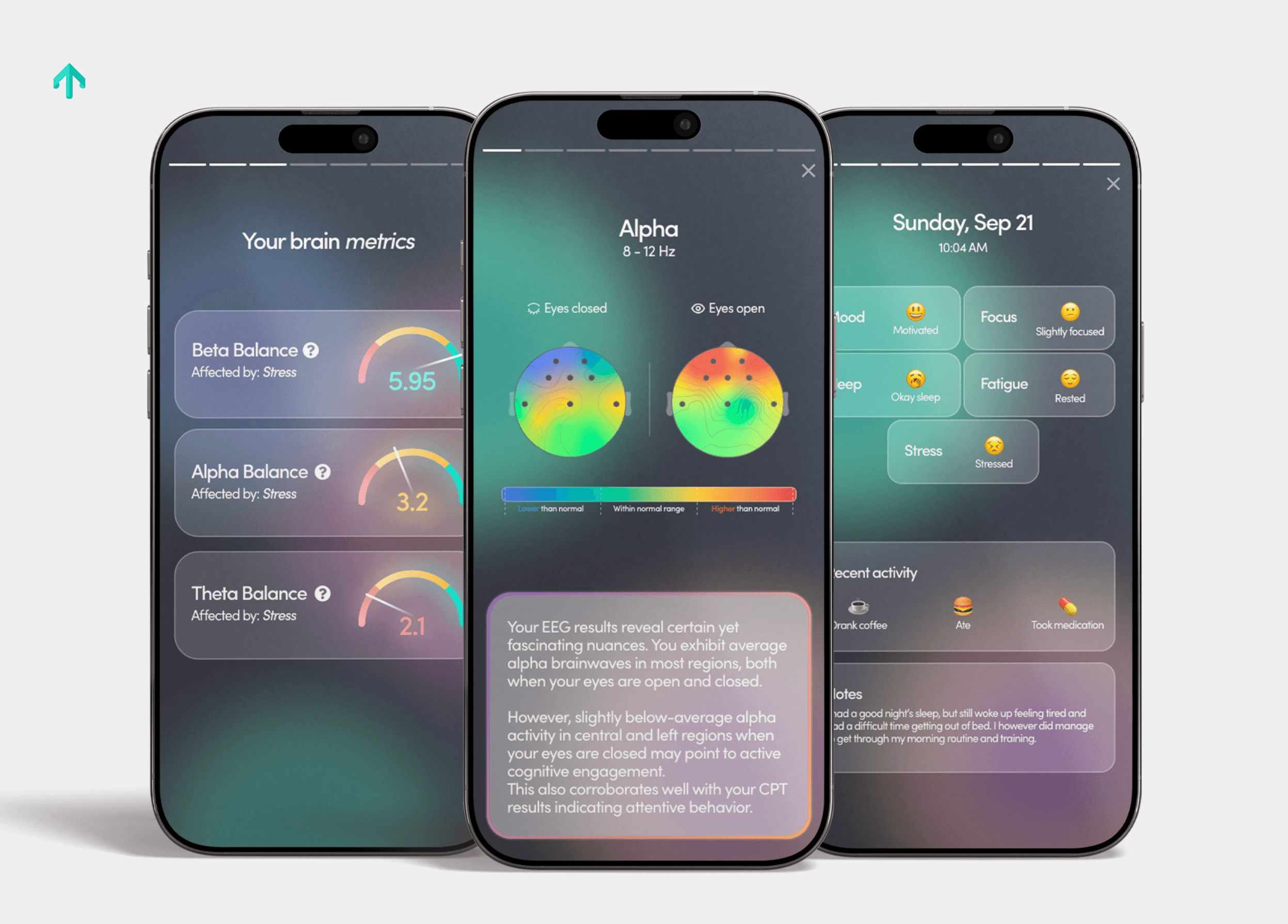
A Brain Snapshot is a three-minute EEG recording designed to capture aspects of your brain activity at a particular moment.
Sensors placed on the scalp measure electrical activity in the brain and show how activity is distributed across different brainwave frequencies.
Brain Snapshots also include metrics derived from the EEG recording, such as cognitive load, which reflects how much mental processing is happening during the measurement.

A Snapshot is exactly that: a snapshot in time. It cannot tell us that reading caused a particular change, and it is not a diagnosis. In this experiment, we're simply comparing what the reader's EEG looked like before and after each activity.
A Quick Guide to the Brainwaves We'll Mention
Brain activity can be grouped into frequency bands, while Brain Snapshots also calculate metrics that help describe patterns in the recording. None is inherently "good" or "bad", context matters.
Delta is the slowest brainwave band. Dr. Trish Leigh associates higher waking delta with states such as fatigue and brain fog.
Alpha is commonly associated with relaxed wakefulness. Dr. Leigh looks at changes in alpha as one indicator of how readily the brain shifts between more active and more relaxed states.
High beta is a faster brainwave band. Dr. Leigh associates elevated high beta with heightened vigilance, stress, and overthinking.
Engagement reflects how focused and attentive the brain appears during the recording. Higher isn't always better, the context and activity matter.
Mental strain reflects patterns associated with mental tension or cognitive stress during the recording.
Fatigue reflects patterns associated with mental tiredness. A higher score can suggest greater fatigue, but doesn't necessarily mean an activity was harmful or overly demanding.
Alpha Response looks at how much alpha activity changes between eyes-open and eyes-closed states. A stronger response can indicate that the brain is shifting more readily between active and resting conditions.
When elevated high beta appears alongside elevated delta, Dr. Leigh has a memorable way of describing the pattern: "You're wired, and you're tired.
The Physical Book: From "Wired and Tired" to More Settled
Before reading the physical book for 20 minutes, the Snapshot showed higher levels of both high beta and delta, the combination Dr. Trish Leigh describes as "wired and tired." In simple terms, the reader's brain showed signs associated with both mental busyness and fatigue.
After reading, both were lower. The fatigue index also dropped, while engagement remained high. In other words, the brain didn't simply become less active or sleepy. In this particular session, the pattern shifted toward being alert but less mentally "on."

Before and after a physical-book session, high beta and delta appeared lower afterward in this reading.
Dr. Leigh also cautions against interpreting more cognitive effort as a negative. A book that makes you think, connect ideas, or stop and reflect may demand more processing precisely because you're engaging deeply with it.
Research has found a small advantage for reading on paper over screens when it comes to comprehension, particularly for informational texts and when reading under time pressure. But the advantage isn't universal: for narrative texts, studies generally haven't found a meaningful difference between print and digital reading.
The Audiobook: More Engaged, but More Mentally Occupied
The audiobook produced a noticeably different pattern from the physical book.
After 20 minutes of listening, engagement increased, suggesting the reader became more focused and less distractible. Mental strain remained low, but fatigue increased, and alpha adaptability dropped.
Dr. Trish Leigh interpreted this as a brain that was still actively processing the story rather than settling down after it.
In other words, the audiobook appeared mentally engaging without being stressful, but in this session, it also seemed to require more sustained cognitive effort.

Before and after an audiobook session, a different pattern, not a worse one.
One possible difference between a physical and an audiobook is pacing. With a physical book, the reader controls when to pause, slow down, or reread.
An audiobook supplies its own rhythm, which may make the experience feel more continuous. In this experiment, the reader described exactly that, although the Snapshot can't tell us whether pacing explains the EEG differences.
Familiarity with the format may matter, too. Dr. Leigh remembers initially finding audiobooks difficult to follow without being able to see the words. After years of listening during long drives, however, the format became second nature. She even learned to switch from information-heavy books to lighter material when she noticed herself getting tired.
Listening isn't simply a "less active" version of reading. Research shows that reading and listening produce similar levels of comprehension overall, although the advantage can shift depending on the material and whether readers control their own pace. Brain-imaging research also shows that stories engage many of the same meaning and language systems whether we read them or hear them.
The Kindle Paperwhite: Calm, Focused, but Slightly More Tired
For this session, the reader used a Kindle Paperwhite with an e-ink display rather than a conventional backlit screen.
After reading, Alpha Response rose from 16% to 38%, while mental strain stayed low and engagement remained almost unchanged.
The fatigue index increased slightly. Dr. Trish Leigh interpreted the overall pattern as staying focused while becoming more adaptable at rest, but also somewhat more tired.

Before and after an e-ink Kindle session.
That distinction between devices matters. An e-ink Paperwhite is a very different experience from reading on a conventional phone or tablet screen.
But Dr. Leigh notices another difference from print: on a physical page, she can more easily return to an earlier passage, remember where something appeared, and connect ideas across different parts of the book. That's one reason she'll sometimes buy a paper copy of a Kindle book she particularly wants to process or revisit.
As with the other formats, this is one person's before-and-after Snapshot, not evidence that the Paperwhite caused these changes.
Research comparing print and digital reading is mixed. A 2024 meta-analysis of 37 experiments found no significant overall difference in reading comprehension between paper and digital formats, with results varying by reader, text, and reading conditions.
Format | What changed after 20 minutes | Overall pattern in this session |
Physical book | High beta and delta appeared lower; fatigue decreased while engagement remained high | More settled while staying alert |
Audiobook | Engagement and fatigue increased; mental strain stayed low; alpha adaptability decreased | More focused and mentally engaged, but still actively processing |
Kindle Paperwhite | Alpha Response increased substantially; engagement and mental strain stayed relatively stable; fatigue increased slightly | More adaptable at rest while staying focused, with slightly more fatigue |
The Surprise: Why Calm Didn't Show Up
Across the formats, Dr. Trish Leigh expected to see alpha rise, the band she associates with a calmer state. It didn't clearly appear.
She offered a hypothesis about this single result, not a finding. The reader was working through emotionally difficult fiction and felt somewhat guarded. Because the material was triggering, Dr. Leigh reasoned, high beta may have been slower to settle in these readings.
But that doesn't necessarily mean the answer is to choose the calmest book possible.
For Dr. Leigh, another important idea is salience: meaningfulness. What you're reading, how much it matters to you, and how you respond emotionally may all shape the experience. A gripping novel, a difficult memoir, and a light book you read to unwind are unlikely to feel identical simply because they're all "reading."
"Salience is meaningfulness," she says.
Fifteen Minutes, a Cup of Tea, a Front Porch
Dr. Trish Leigh's advice is simple: reclaim fifteen minutes from passive scrolling and give them to a book.
For her, that often means a cup of tea and a few pages on the front porch. "It is not wasting time," she says. The goal isn't to read for hours. It's to make reading something your brain wants to return to.
There may be benefits to making it a habit, too. A 14-year study of older adults found that people who read at least once a week had a lower risk of cognitive decline. The study was observational, so it can't tell us that reading itself caused the difference.
Dr. Leigh's rule is simpler still: choose something engaging enough that "it becomes the thing that your brain is pulling you back to."
Choose the Book That Brings You Back to Yourself
If this experiment looked like a contest to crown the best reading format, that isn't where Dr. Trish Leigh lands. The physical book, audiobook, and Kindle Paperwhite each produced a different pattern, and there was no universal winner.
Her advice is to choose the format you'll actually use and pay attention to how it affects you. That may depend on more than whether it's print, audio, or e-ink: the book itself, how familiar you are with the format, how much control you have over the pace, and what state you're in when you begin may all matter.
"Recognize your state and how your reading, and all your different behaviors, are affecting you," she says.
Perhaps that's the more interesting takeaway from the experiment. Reading isn't one single experience for the brain. The format matters, the book matters, and so does the person reading it.
Curious about what your own brain activity looks like? Explore Myndlift Brain Snapshots.
FAQs
What happens to your brain when you read a book?
Reading recruits multiple brain systems involved in recognizing words, language, attention, memory, and constructing meaning. The exact pattern can vary depending on what you're reading, how you're reading it, and your own state at the time.
Is reading a physical book better for your brain than reading on a Kindle?
Not necessarily. Research comparing print and digital reading has found relatively small and inconsistent differences overall. Some studies find an advantage for print in particular circumstances, especially with informational texts or time pressure, while narrative reading often shows little meaningful difference between formats.
Is listening to an audiobook the same as reading?
Not exactly, but the two have considerable overlap. A meta-analysis of 46 studies found no reliable overall difference in comprehension between reading and listening, although factors such as pacing, material, and whether readers can control their own speed can affect the result.
Does reading reduce stress?
Reading has been associated with lower stress and better well-being, but not every book will have a calming effect on every reader. Content and emotional response matter too — something our experiment highlighted when emotionally difficult fiction produced a different experience from what we expected.
Is reading before bed good for your brain and sleep?
It may be. One randomized trial found that people assigned to read a book in bed for a week were more likely to report improved sleep quality than people asked not to read before bed. The type of reading device may also matter, particularly when comparing a physical book or e-ink reader with a light-emitting screen.
Can reading help protect against cognitive decline?
Regular reading has been associated with a lower risk of cognitive decline later in life. In one 14-year study, older adults who read at least weekly had lower odds of cognitive decline, although observational research can't establish that reading itself caused the difference.
Can I do my own brain experiments with EEG?
Consumer EEG tools can make simple self-experiments possible. For example, Myndlift Brain Snapshots use a three-minute EEG recording to track metrics such as engagement, fatigue, Alpha Response, and brainwave activity, making it possible to compare readings before and after activities like reading, meditation, exercise, or coffee.

References
Delgado, P., Vargas, C., Ackerman, R., & Salmerón, L. (2018). Don’t throw away your printed books: A meta-analysis on the effects of reading media on reading comprehension. Educational Research Review, 25, 23–38. https://doi.org/10.1016/j.edurev.2018.09.003 ScienceDirect
Clinton-Lisell, V. (2022). Listening ears or reading eyes: A meta-analysis of reading and listening comprehension comparisons. Review of Educational Research, 92(4), 543–582. https://doi.org/10.3102/00346543211060871 Sage Journals
Deniz, F., Nunez-Elizalde, A. O., Huth, A. G., & Gallant, J. L. (2019). The representation of semantic information across human cerebral cortex during listening versus reading is invariant to stimulus modality. Journal of Neuroscience, 39(39), 7722–7736. https://doi.org/10.1523/JNEUROSCI.0675-19.2019 PubMed Central (PMC)
Li, Y., & Yan, L. (2024). Which reading comprehension is better? A meta-analysis of the effect of paper versus digital reading in recent 20 years. Telematics and Informatics Reports, 14, 100142. https://doi.org/10.1016/j.teler.2024.100142 ScienceDirect
Chang, Y.-H., Wu, I.-C., & Hsiung, C. A. (2021). Reading activity prevents long-term decline in cognitive function in older people: Evidence from a 14-year longitudinal study. International Psychogeriatrics, 33(1), 63–74. https://doi.org/10.1017/S1041610220000812
Related posts