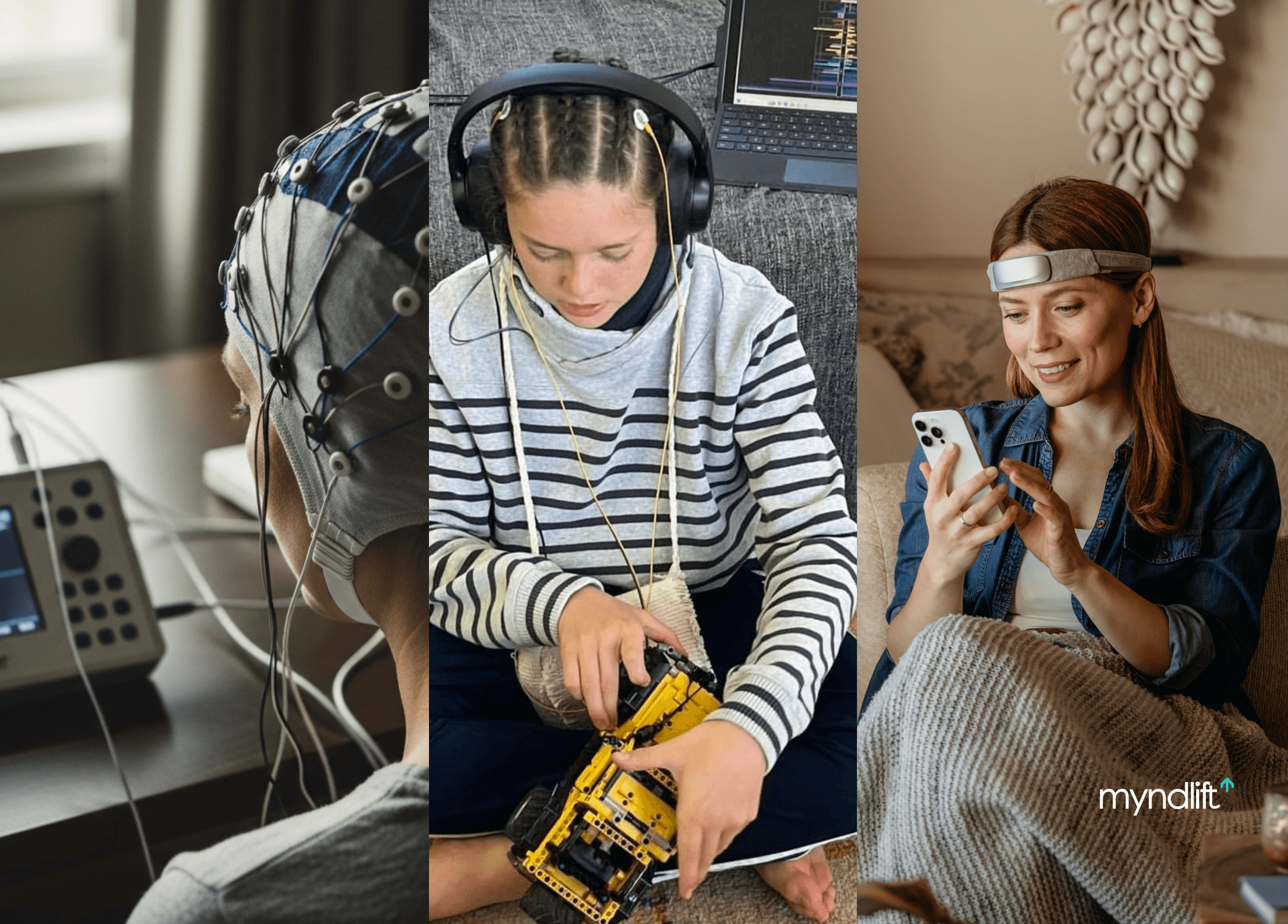

Myndlift offers personalized at-home and in-clinic neurofeedback to help alleviate ADHD and anxiety symptoms, address sleep difficulties, manage stress, and improve cognitive performance.
Sens.ai focuses on self-guided brain training for cognitive enhancement, meditation, stress resilience, and general brain wellness.
Myndlift's guided program combines qEEG assessments, attention testing, and a dedicated Neuro Coach who tailors and adjusts training protocols.
Technology differs: Myndlift supports EEG and fNIRS-based training, while Sens.ai combines EEG neurofeedback, HRV biofeedback, and near-infrared light stimulation.
For clinicians: Myndlift offers a comprehensive neurofeedback platform with qEEG brain mapping, cognitive assessments, customizable protocols, and remote client monitoring. Sens.ai offers BrainYears functional brain age assessments and app-guided training programs.
Myndlift and Sens.ai both bring EEG neurofeedback into your home, but what if your goal is more specific than simply improving focus or feeling calmer?
If you're looking to alleviate ADHD or anxiety symptoms, reduce stress, or improve sleep, the way your neurofeedback training is designed and monitored can matter just as much as the technology itself.
Myndlift takes an assessment-based approach, with a Neuro Coach who personalizes your training around your symptoms and goals. Sens.ai combines EEG neurofeedback, HRV biofeedback, and light stimulation in one headset, offering primarily self-guided programs for cognitive performance and general wellness.
Here's how the two compare in terms of technology, training, professional support, and cost.
Start by defining your goals
You wouldn't choose a workout plan without knowing what you're training for. The same goes for neurofeedback. Before comparing features and pricing, ask yourself what you want to achieve.
If this sounds like you… | Worth considering |
I have ADHD or struggle with anxiety, and I'd rather have a professional guide my training than figure everything out myself. | Myndlift |
I'm into biohacking and love experimenting with different technologies to see how they affect my brain and performance. | Sens.ai |
I've been meditating for years and want to explore deeper meditative states using technology, without working with a coach. | Sens.ai |
I have trouble focusing or sleeping, and I want to understand what's going on rather than just trying another app. | Myndlift |
My job or sport demands a lot of mental focus, and I want a training plan tailored to how my brain performs. | Myndlift |
How Myndlift Works
Myndlift is an at-home neurofeedback program that combines personalized brain training, comprehensive assessments, and one-on-one guidance from a dedicated Neuro Coach.
Your training is tailored to your goals, whether you're working on ADHD or anxiety symptoms, sleep difficulties, stress regulation, or peak performance.
Here's what to expect:
Choose your equipment. Myndlift works with different Muse headbands, including Muse 2, Muse S, and Muse S Athena. The setup includes an external EEG electrode that can be positioned over different areas of your scalp. With Muse S Athena, you also get access to functional near-infrared spectroscopy (fNIRS), which measures changes in blood oxygenation associated with brain activity.
Complete your initial assessment. You'll start with EEG brain mapping (qEEG), a sustained attention test (CPT), and symptom questionnaires. These establish a baseline for your training.
Meet your dedicated Neuro Coach. In a one-on-one session, your coach reviews your assessment results, discusses your goals, and develops a personalized neurofeedback protocol. You'll continue meeting with your coach throughout the program to discuss progress, challenges, and adjustments.
Train at home. Use the Myndlift app to complete neurofeedback sessions through interactive games or streaming content, including YouTube and Netflix. For example, the video you're watching may become dimmer when your brain activity moves away from the training target and clearer when it returns.
Measure your progress. Your Neuro Coach can review your training data, identify patterns across sessions, and adjust your protocol when needed. Follow-up EEG measurements, attention tests, and symptom questionnaires help you evaluate progress beyond individual training scores.
Myndlift also offers a self-guided option for users who don't need ongoing coaching, although the assessments, personalized guidance, and one-on-one sessions described above refer to its coached program.
Practical considerations:
Cost: Myndlift kits start at $249, with the guided program costing $150/month. A self-guided option is available for $29/month.
Time commitment: Plan for approximately 20–30 minutes of training, 3–5 times per week.
Comfort and setup: Uses a lightweight Muse headband with an external EEG electrode. The headband is relatively portable, but you'll need to position the additional electrode before training. Once you've connected your headband and positioned the external electrode, the Myndlift app guides you through checking signal quality before you begin training.
How Sens.ai Works
Sens.ai is an at-home brain-training system that combines EEG neurofeedback, heart rate variability (HRV) biofeedback, and transcranial photobiomodulation (tPBM), a technology that uses near-infrared light stimulation.
Its programs focus on cognitive performance, stress resilience, meditation, and brain health, with most training managed independently through the app.
Here's what to expect:
Get your headset. Sens.ai uses its own all-in-one headset with three EEG sensors, built-in headphones, and near-infrared light stimulation.
Complete your initial assessments. Sens.ai offers brain and cognitive assessments to establish baseline measurements, including attention and processing-speed metrics. These help you track changes as you train.
Choose a Session or Mission. Individual Sessions typically last 15–20 minutes, while Missions organize training into multiweek programs. As you progress, additional training experiences become available, including more advanced protocols for concentration, meditation, and gamma brainwave activity. This gives you a structured path to follow, although you won't necessarily have access to every training mode from the beginning.
Train using different technologies. Depending on the program, you'll use EEG neurofeedback, HRV biofeedback, or near-infrared light stimulation (tPBM). During neurofeedback sessions, immersive audio changes in response to your brain activity, becoming richer as you reach the target state. Other experiences combine guided audio, soundscapes, and light stimulation, giving you several ways to train within the same headset.
Track your progress. After each session, Sens.ai displays performance scores and other metrics, such as time spent in a target brain state. Its GeniusPulse assessments also provide cognitive measurements you can compare over time. The system emphasizes these summaries rather than giving users direct access to raw EEG recordings or third-party analysis tools.
Practical considerations:
Cost: The Sens.ai headset is listed at $1,250, with a Personal Membership costing $29/month when billed annually or $60 month-to-month.
Time commitment: Individual sessions typically take 15–20 minutes, while Missions provide structured training over several weeks.
Ease of use: Before each session, you'll need to moisten the EEG sensors and position the headset to establish a reliable signal. This can take a few minutes, particularly if you have thick hair or need to adjust the sensor contact.
For Clinicians: How Do Myndlift and Sens.ai Compare?
Both Myndlift and Sens.ai offer solutions for professionals, but they're designed for different clinical workflows.
Myndlift for Clinicians allows practitioners to provide neurofeedback in their clinic or remotely, using EEG assessments, individualized training protocols, and ongoing progress monitoring.
Clinicians can manage their clients' neurofeedback training, review session data, and adjust protocols based on their needs.
Sens.ai BrainYears Unlimited focuses on measuring and tracking cognitive performance. Clinics can administer a 20-minute BrainYears assessment, receive a report covering functional brain age and cognitive performance, and recommend structured at-home Missions.
Clients can then return for follow-up assessments to see how their measurements have changed.
The main distinction is the practitioner's role: Myndlift gives clinicians tools to develop and manage individualized neurofeedback protocols, while Sens.ai provides a standardized assessment-to-training pathway, with the app guiding clients through their Missions.
Myndlift vs. Sens.ai: Side-by-Side Comparison
Feature | Myndlift | Sens.ai |
EEG neurofeedback | ✅ | ✅ |
fNIRS training | ✅ | ❌ |
HRV biofeedback | ✅ | ✅ |
Near-infrared light stimulation (tPBM) | ❌ | ✅ |
Initial brain and cognitive assessments | ✅ | ✅ |
Personalized training | Coach-guided | App-guided |
Dedicated human Neuro Coach | ✅ | ❌ |
Progress tracking | ✅ | ✅ |
Upfront equipment cost | From $249 | $1,250 |
Monthly membership | $150 guided / $29 self-guided | $29 annually billed / $60 monthly |
Professional/clinic offering | Clinician-managed neurofeedback | BrainYears assessments + app-guided training |
Ultimately, the biggest difference isn't the hardware, but how your training is personalized and supported.
If you want a professional to help you understand your brain activity and adjust your training around your needs, Myndlift offers that structure. If you'd rather explore different brain-training technologies independently, Sens.ai gives you that flexibility.
FAQs
Can I use Myndlift with a Muse headband I already own?
Yes. Myndlift is compatible with several Muse headbands, including Muse 2, Muse S, and Muse S Athena. If you already own a compatible device, you may not need to purchase another headband. You'll still need the external EEG electrode and the appropriate Myndlift membership.
Can I use Myndlift without a Neuro Coach?
Yes. Myndlift offers both guided and self-guided options. The guided program includes a dedicated Neuro Coach who reviews your assessments, develops your training protocol, and monitors your progress. The self-guided option is designed for people who prefer to train independently.
Does Sens.ai offer personalized neurofeedback?
Yes, but personalization works differently. Sens.ai uses assessments and app-based recommendations to guide users toward suitable training programs. Myndlift's guided program uses EEG measurements, attention testing, and symptom questionnaires to develop individualized protocols that a Neuro Coach can adjust over time.
Can I use Myndlift or Sens.ai to help with ADHD?
Myndlift's guided program can be personalized around attention-related difficulties, including ADHD symptoms, using assessments and ongoing coaching. Sens.ai offers training programs focused on attention, concentration, and cognitive performance. However, neither device should be considered a guaranteed treatment for ADHD or a replacement for professional medical care.
Can I use Sens.ai without a subscription?
Yes, but with limited functionality. According to available product information, you can still access basic Boost modes and HRV training without an active membership. However, full EEG neurofeedback programs, Missions, and cognitive assessments require a paid subscription. Sens.ai includes 60 days of membership access with the headset, so it's worth factoring the ongoing cost into your decision.

Related posts